Seven skills
You write what you want. Your AI knows how
- start
- template-aufbau
- copywriting
- design-system
- seo
- qualitaetspruefung
- systemwissen
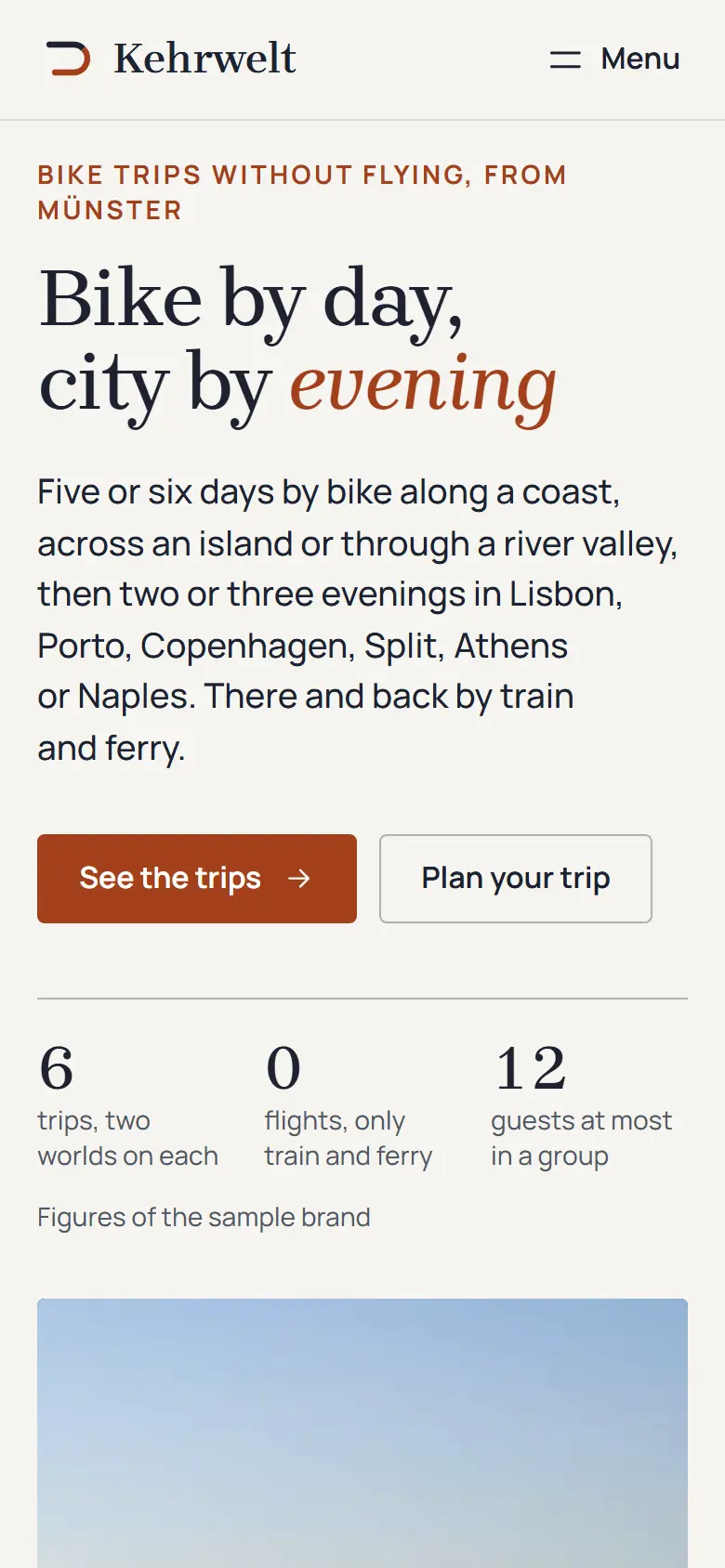
By day on the bike, by evening in the city, and no flight in between

Day picture on the Bay of Naples, the city mirrored below
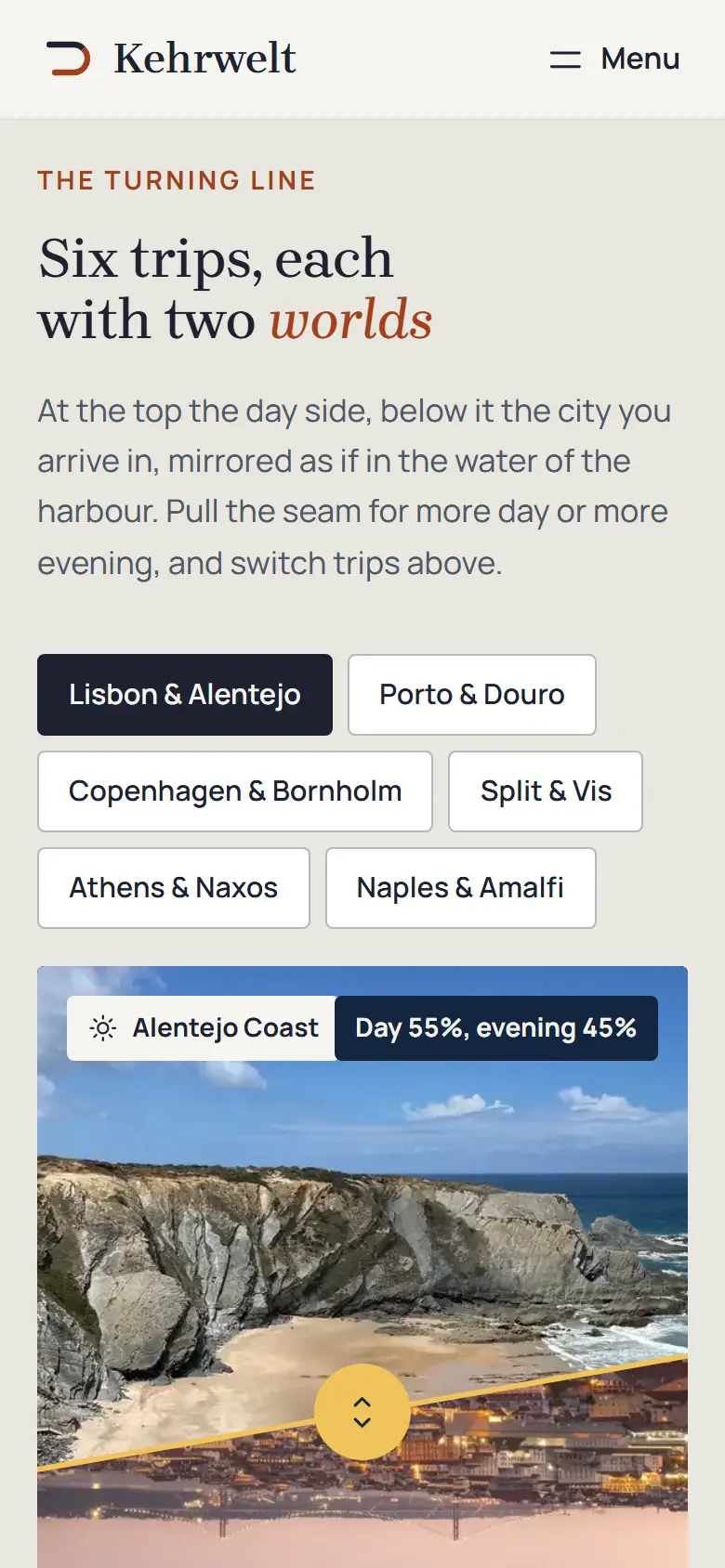
Six trips to pick from, the seam opens day or evening
Six trip cards, then the trip finder in four tabs
A slider from seven to the harbour, then the turning arc
Journey CO2 for all six trips, then three sample reviews
Departure board, journal, questions and a mirrored close
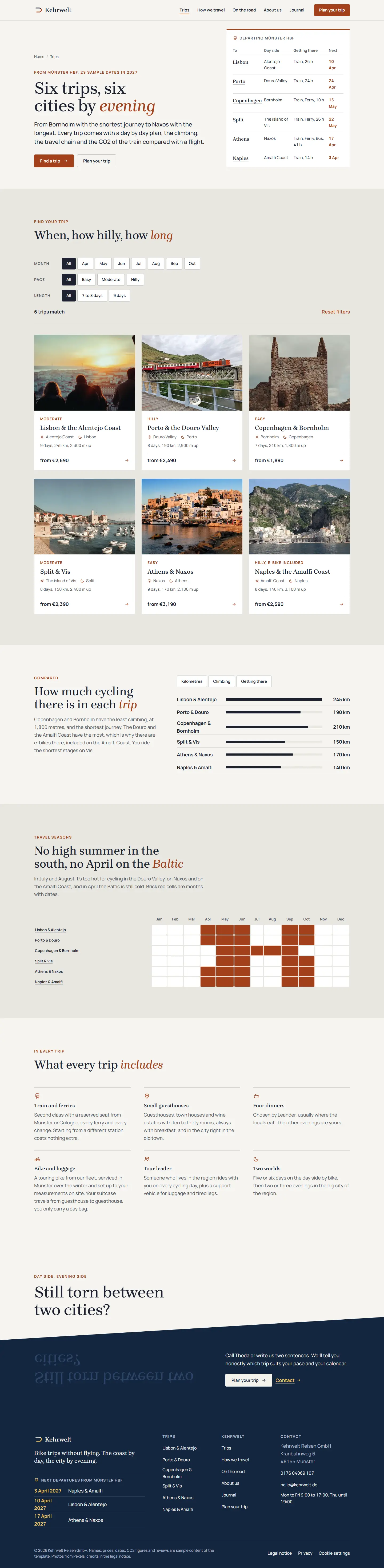

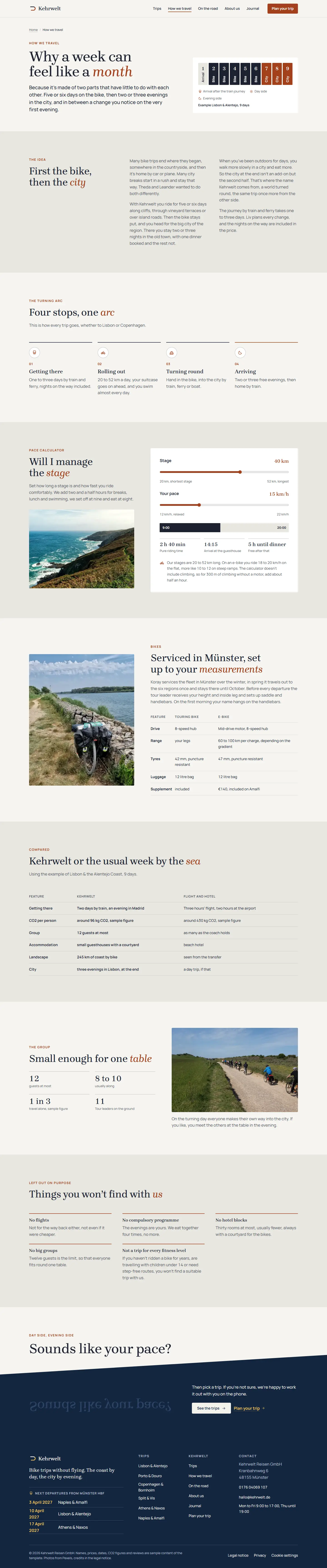
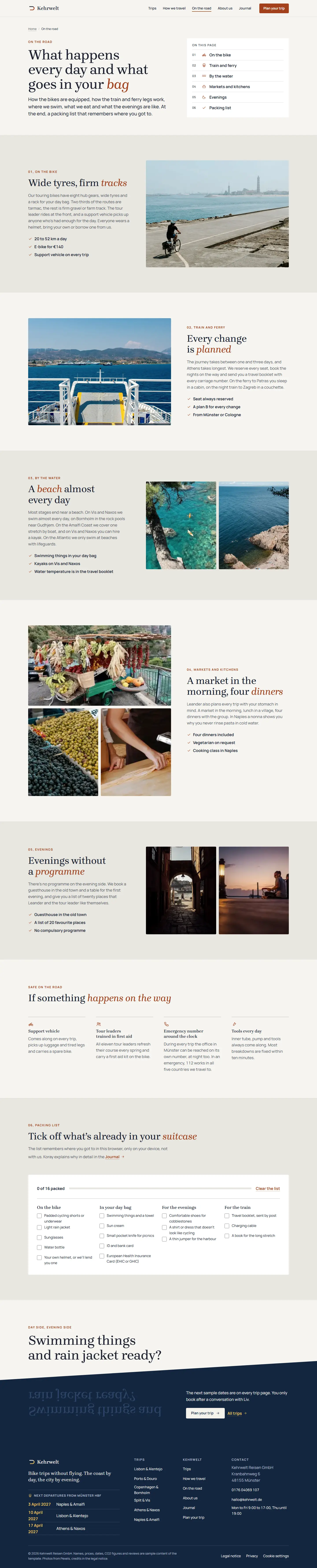
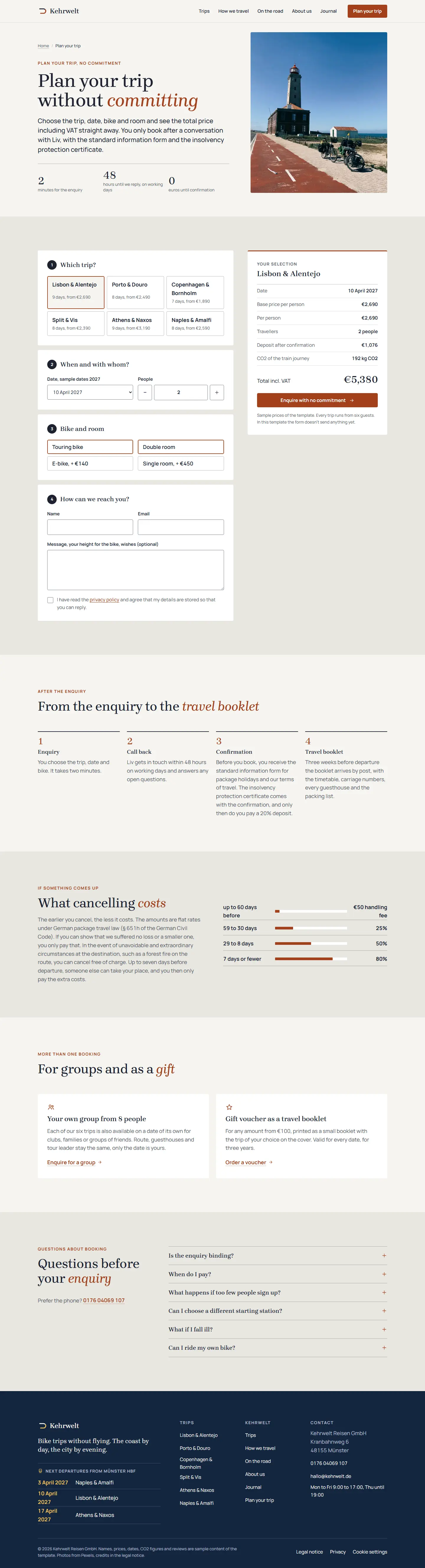

The evening city mirrored as if in harbour water
Mouse, finger or keyboard, with value text
By button on the home page, fixed per trip page
Both halves stay put without scripts
You write what you want. Your AI knows how
The rules of the template for your AI
Not just squeezed together
Strategy and blueprint in the project
Switched to your brand in one sentence
Small operators of group cycling holidays
Travel by train and ferry instead of flying
Agencies that deliver travel websites reliably
Secure payment via Stripe, the ZIP arrives right after
Rather have it done for you?AI Website Service · €899First steps in the docs Template, service and custom pricing compared
The signature feature of the template. Every trip appears as two pictures stacked on top of each other, the day side above with coast, island or valley, the evening city below, mirrored as if in the water of a harbour. The diagonal seam between them can be dragged, by mouse anywhere on the stage, by finger on the handle, and with arrow keys, Page Up, Page Down, Home and End. Depending on its position the details of the smaller side step back, and the handle tells screen readers how much day and how much evening is in view.
On the home page with six trips to choose from, where buttons above the stage switch the trip. On each of the six trip pages it opens the page beside the fact sheet, with distance and evenings in its labels. It is fed by the pictures and details of each trip in src/data/site.ts, so a new trip gets its own turning line automatically.
Yes. Every heading and every text is there without scripts. The turning line shows both halves fixed and readable, the Day clock becomes a list with both pictures, the Pace calculator and trip planning show their example from the same calculation, the packing list reads “0 of 16 packed”, accordions stay open, tabs stack, and the menu on phones opens.
They are sample values, rounded and marked as a sample calculation. Only the CO2 of the return journey from Münster is counted, the extra warming from flights at high altitude is left out, and the page says so under every comparison. The journal piece Why we don’t fly explains how the calculation works. If you do not check the figures yourself, let your AI take the numbers out and keep the comparison as the plain journey legs.
Funkenmoos is built for glamping sites with tents and trips and works out how dark the night is at each camp. Lauschgrat is for owners of several holiday cabins with a night value in decibels and a price calculator including tourist tax. Kehrwelt sells guided group trips combining bike and city, with dates, travel by train and ferry, trip planning with a total price and the duties of a tour operator.
The base price of the trip per person in a double room, plus the €140 e-bike supplement and the €450 single room supplement, times the number of travellers. On the Amalfi Coast the e-bike is included. The summary shows the total incl. VAT, a 20% deposit and the CO2 of the train journey. The starting value is two people on Lisbon and Alentejo, so €5,380 with a €1,076 deposit. The rules sit once in src/lib/preis.ts, the supplements under aufpreise in src/data/site.ts, and the value without scripts is calculated at build time with the same function.
From a stage between 20 and 52 km and your own speed between 12 and 22 km/h it works out the riding time, the arrival at the house and the free hours before dinner. The start is at nine, and it adds two and a half hours for breaks, lunch and a swim. Climbing is deliberately left out, and the note below says how much time 300 m of climbing costs without a motor. The stages come from the trip data, the calculation sits in src/lib/tempo.ts.
As a rule yes, and the template is built for it. Trip planning names the standard information form and the insolvency protection certificate before the deposit, the cancellation charges are flat rates under German package travel law (§ 651h of the German Civil Code) with notes on lower actual costs, unavoidable circumstances and a substitute traveller, and the legal notice explains the duties of a package organiser in Germany. Check customer money protection, travel terms and your cancellation rates before going live, these notes are not legal advice.
Every date sits as day and month in src/data/site.ts, and the build works out the year for each date, this year if the date is still ahead, otherwise next year. So every trip always shows its next departures, and the page adds sample dates with the year. Anything that has passed is hidden by the script everywhere in case the site has not been rebuilt for a while, and trip planning only offers future dates. The info evenings on the contact page are the first Thursdays from the build date, three of them shown, and the year in the footer comes from the build date too.
Three groups, month from April to October, pace easy, moderate or hilly, and length seven to eight or nine days. A counter says how many trips match, if none does a sentence with a link to the enquiry appears, and a button resets everything. The months come from the dates of each trip, and the build checks that travel months and dates agree.
A typical cycling day in seven stations, from breakfast at seven to the harbour at ten. A slider picks the time, the matching station lights up, and from the evening on the picture changes from the bike on the coast to a lane in the city. Without scripts the whole list stands there with both pictures.
With an entry under reisen in src/data/site.ts, with country, day side and evening city, days, distance, climbing, price, day by day plan, journey legs, CO2, dates and questions. That creates the trip page, turning line, card, departure board, filter, comparison, month table, trip planning and footer. The alt texts of the pictures sit in src/data/alt.ts.
No, there is no booking system built in. Trip planning collects a non binding enquiry with trip, date, bike and room, and the booking follows after the conversation with the standard information form and insolvency protection certificate. If you use a booking system, let your AI put its link or embed on the form and buttons and add it to the privacy policy and consent.
Both forms check name, email and the privacy policy tick box, the contact form checks the message too. They mark errors at the field, and the message disappears as you type. Afterwards a confirmation appears that says plainly the template sends nothing. The forms are set up with method="post", your AI sets up the sending.
Yes, with some rework. Day side and evening side carry any trip with two parts, walking and a city, say, or sailing and a harbour. Your AI renames bike, stages and climbing and drops the Pace calculator and the bikes, while the turning line, dates, journey legs and trip planning stay.
No. Operator, team, prices, dates, CO2 figures and sample reviews are invented, and the footer of every page says so. The address in Münster is a sample, the phone number comes from the range the German Federal Network Agency keeps free for media use. Regions, cities, stations and ferry routes such as the Alentejo, the Douro, Bornholm, Vis, Naxos, the Amalfi Coast or Ancona to Patras are real, houses and restaurants are not named.
The 66 photos come from Pexels under the Pexels licence, none of them is AI generated. They show neither the trips described nor the team. People appear on 21 photos, none with a recognisable face, and there is no model release. src/data/bildnachweis.json and the legal notice name the photographer of every picture, the file adds source and licence.
Because no stock photo should sit next to a real name. The four people in Münster appear as initial plaques with role and a line of their own, and the note below says that your own team photos belong there. Reviews appear without faces and are marked as sample reviews.
No. Brygada 1918 and Manrope sit in public/fonts/, the photos in the project, while mark, map and bars are drawn. The browser runs its own JavaScript without a library, around 6 KB gzipped. The cookie window writes the choice to the dataLayer, and statistics and marketing are not connected to any service.
Yes. Every page has its own title, description and breadcrumbs, plus a TravelAgency schema with address and opening hours. Every trip carries TouristTrip with an offer and FAQPage, the trips page ItemList, the articles BlogPosting, About us AboutPage and Contact ContactPage. Astro builds the share images at 1200 by 630 pixels from a photo of each page. Legal notice, privacy policy and 404 are set to noindex and left out of the sitemap.
Informally throughout, and the operator speaks as we. The script texts sit in src/data/texte.ts, the openings of all pages in src/data/heros.ts, the content in src/data/site.ts, inhalte.ts and journal.ts. Your AI switches to a formal tone if your business prefers it.
Yes. In the English package the whole website is in English, with an English knowledge layer and English skills. The scripts format numbers, euros and times through the browser in the language of the page.
Anywhere static files are allowed. Astro builds the site into a folder of finished HTML that you upload to your host. Before that your AI sets your own domain in astro.config.mjs and robots.txt, and the website derives every other address from it.
Yes. Pay once, yours forever, for your own projects and client projects. You get the complete source code without a watermark.
No. You tell your AI in the project folder what should change, and it finds the place through CLAUDE.md and the seven skills. If you want to make changes yourself, trips, prices, dates and supplements sit in src/data/site.ts and team, history and packing list in src/data/inhalte.ts.
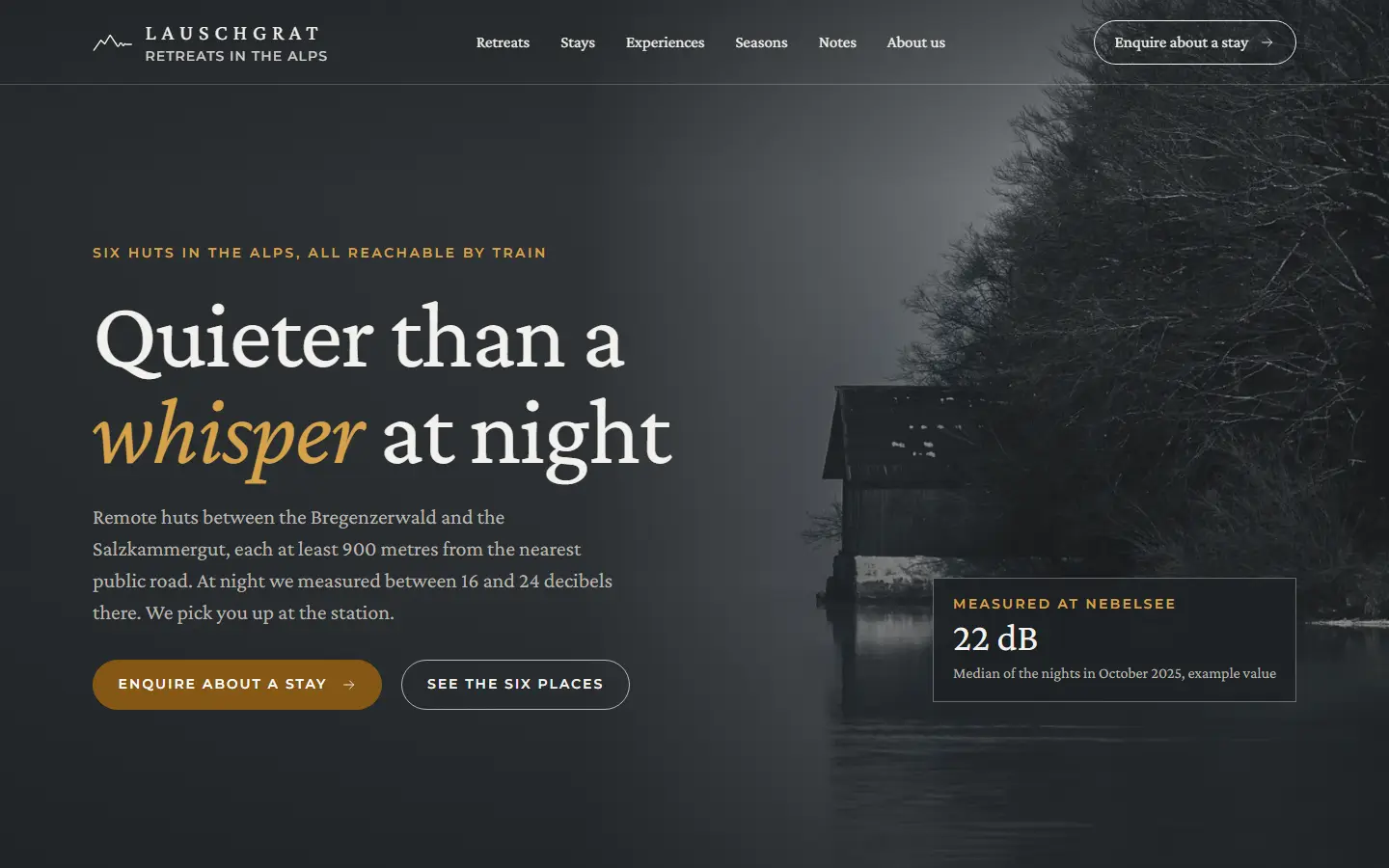 New in the marketplace
The website for remote holiday cabins that shows for every place how quiet the night is there.
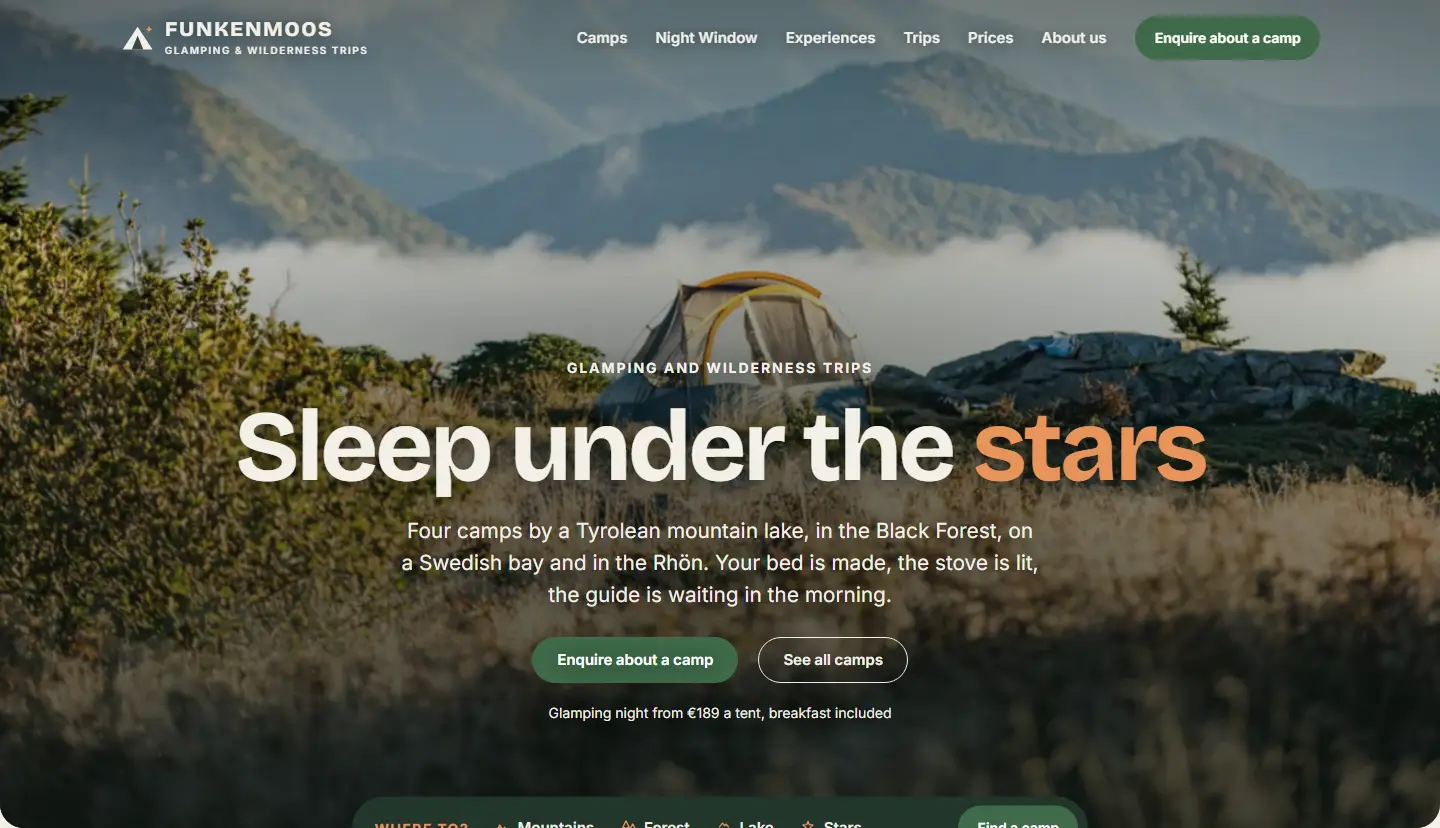
The glamping website with a Night Window that works out real darkness for every camp and night.
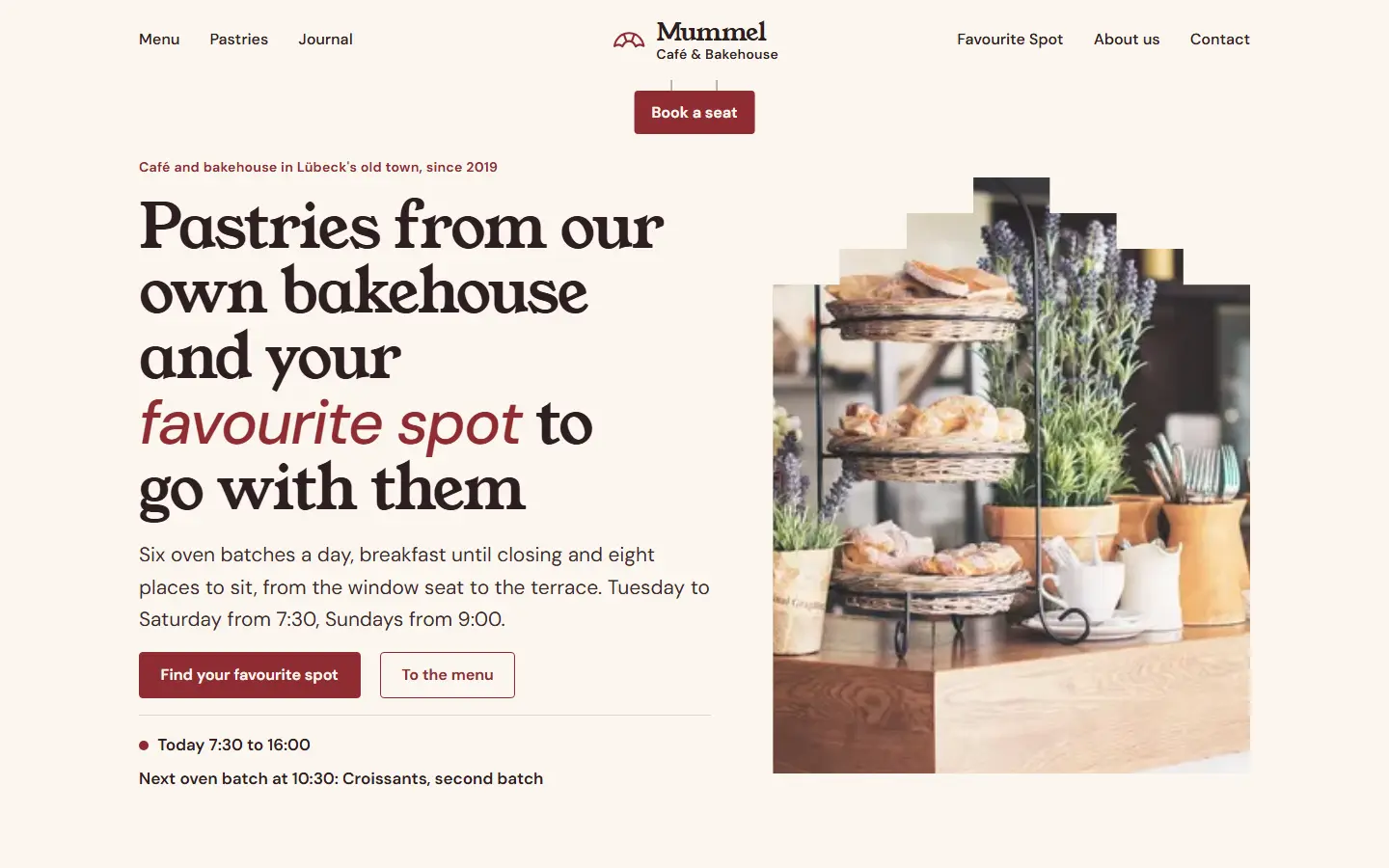 New in the marketplace
The café with its own bakehouse whose floor plan recommends every guest the right spot for coffee and pastries.
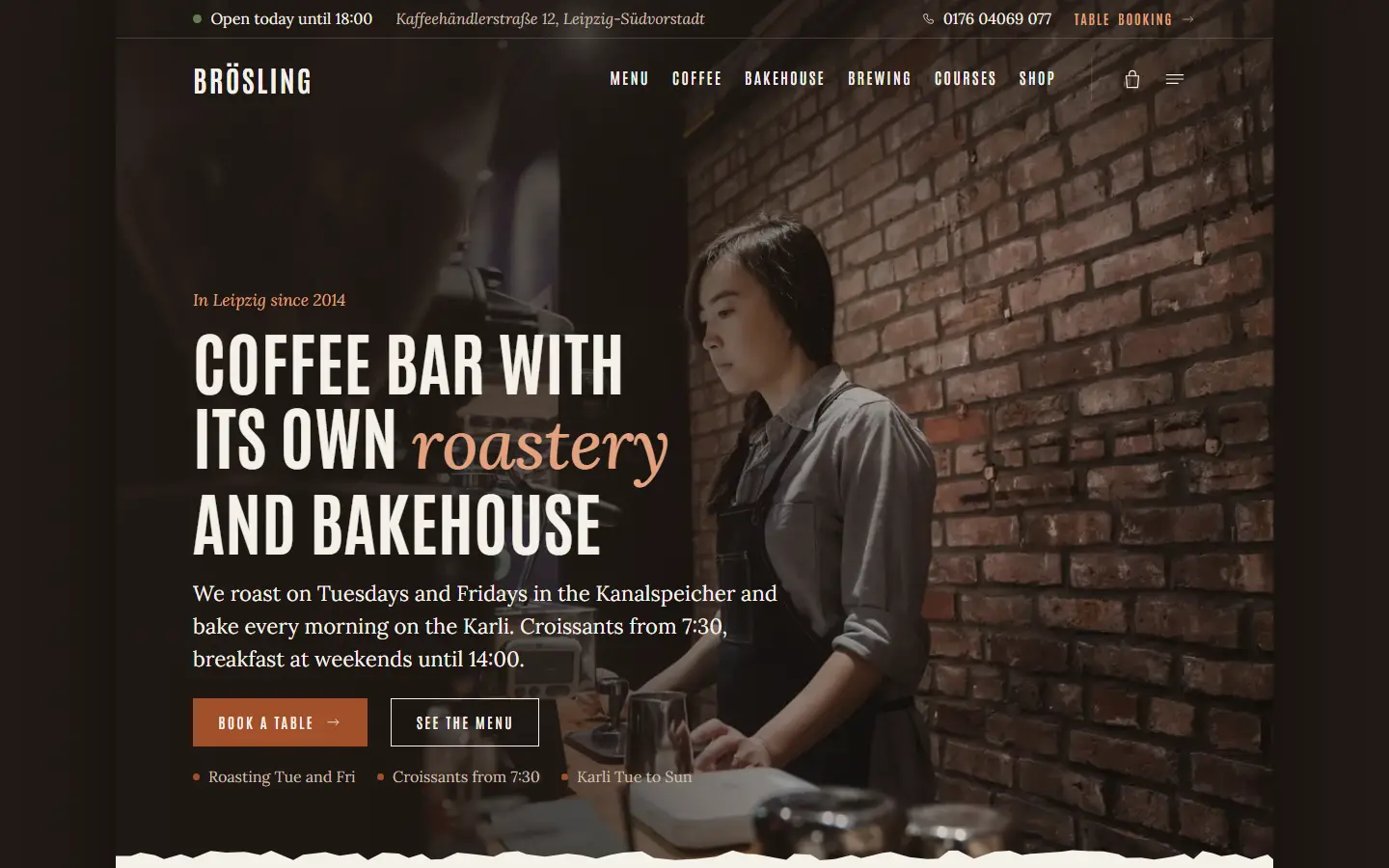 New in the marketplace
The coffee bar with a bakery whose cup in cross-section shows what is inside and which pastry goes with it.
We would like to understand how this site is used with Google Analytics, loaded via Google Tag Manager. Nothing loads and no cookie is set before your ok. You can change your choice anytime in the privacy policy.
Choose what may be active. You can change your selection anytime in the privacy policy.