Seven skills
You write what you want. Your AI knows how
- start
- template-aufbau
- copywriting
- design-system
- seo
- qualitaetspruefung
- systemwissen
Six cabins, and every one says how quiet the night is there

Boathouse in the fog, one italic word, a 22 dB panel
Three cabins with altitude and night value, then the path
Six places as a ridge, 24 hours and the comparison
The place finder ranks the six places with points
Four steps, then stove, sauna, night and basket
How the places change, then the enquiry
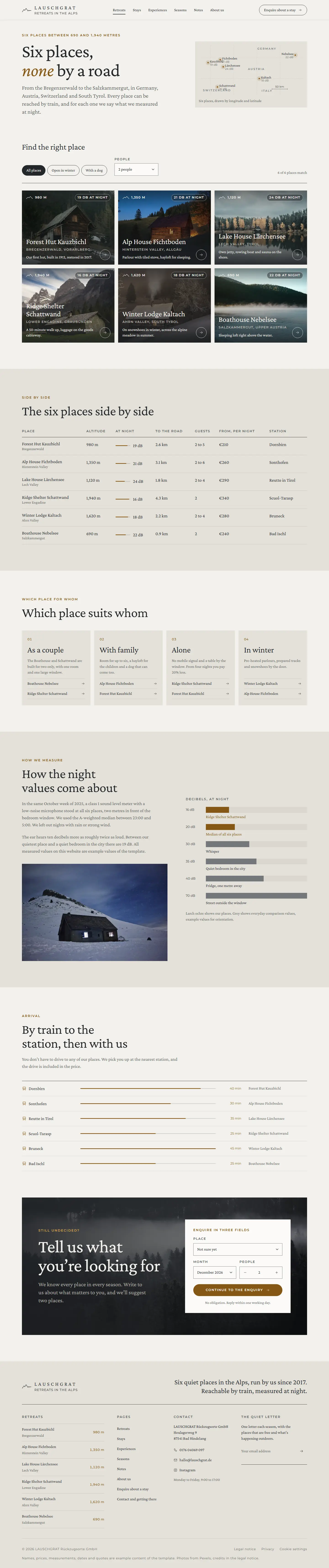



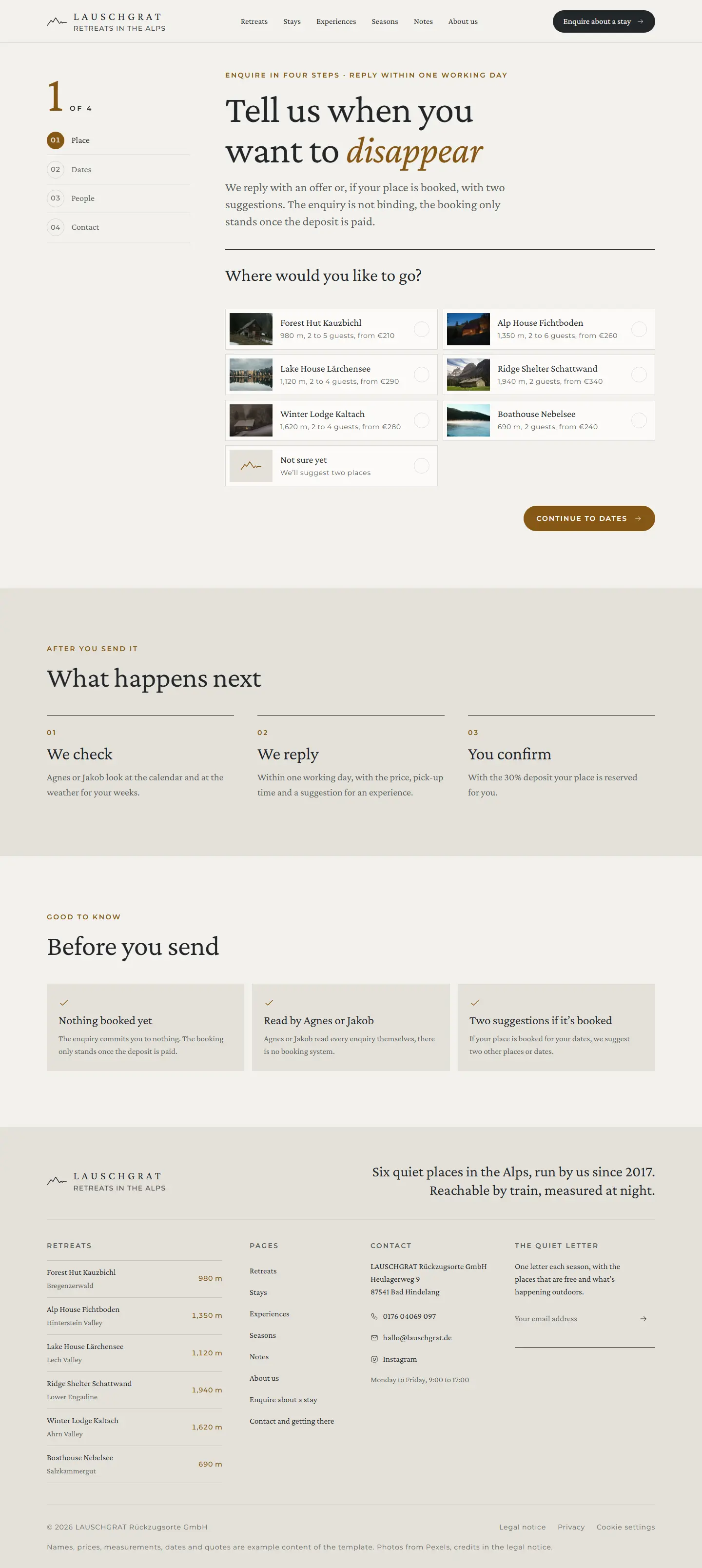

Median from 23:00 to 5:00, marked as a sample
Measured at night, estimated by day, with slider
Six bars, marks at 20 and 30 dB
Curve and comparison work without scripts
You write what you want. Your AI knows how
The rules of the template for your AI
Not just squeezed together
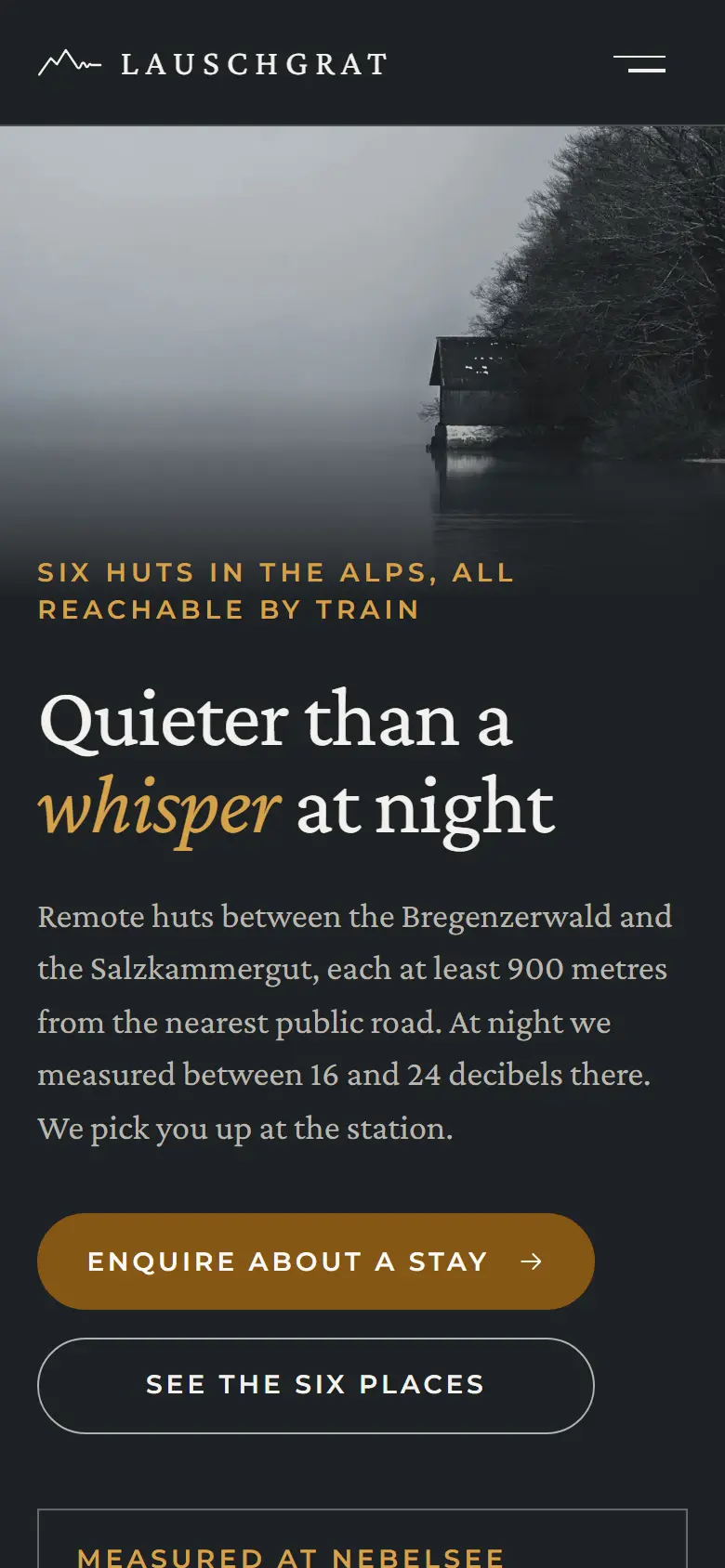
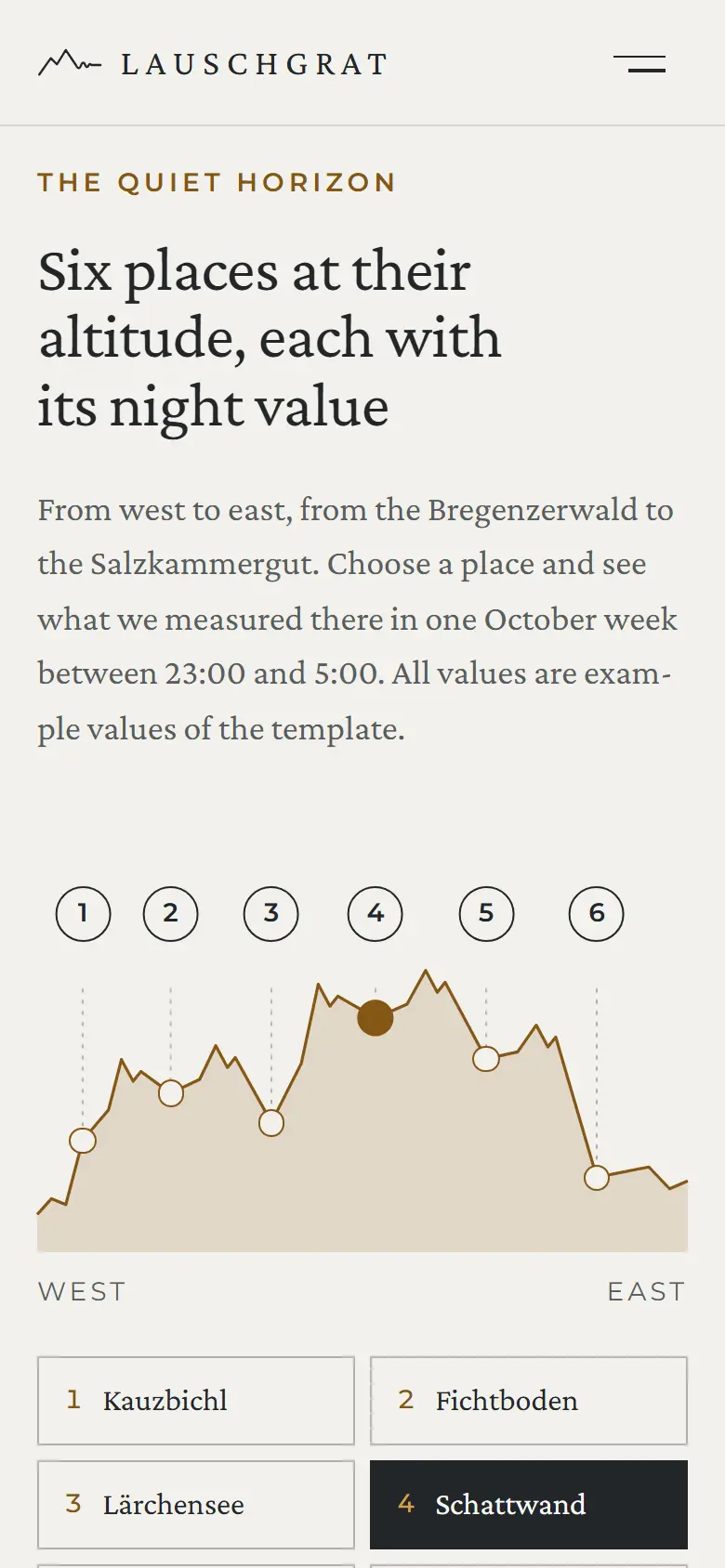
Strategy and blueprint in the project
Switched to your brand in one sentence
Owners of several remote cabins
Holiday homes across several regions or countries
Agencies that deliver holiday home websites reliably
Secure payment via Stripe, the ZIP arrives right after
Rather have it done for you?AI Website Service · €899First steps in the docs Template, service and custom pricing compared
They are sample values of the template, and the page says so at every value. It tells a plausible method, one week in October with a class 1 sound level meter outside the bedroom window, counted as the A-weighted median between 23:00 and 5:00, nights with rain or strong wind left out. That is how the Retreats page and the note on measuring quiet put it. If you measure yourself, you enter your values, if you do not, your AI takes the decibels out.
From three numbers per place in src/data/site.ts, the night value, a daytime value and a peak in the afternoon. The function kurve() turns them into 24 hourly values. Only the night is measured, the day is estimated, and the heading of every curve says “measured at night and estimated by day”. If you have real hourly values, you enter them as a list.
All six places at the same hour as bars, with two dashed marks, rustling leaves at about 20 dB and a whisper at about 30 dB. The hour slider moves curve and comparison together. Below the comparison it says that the marks are sample values for orientation and that only the own places were measured.
No. The Bortle sky class appears as a fact line in the fact sheet, the only calculation is about sound. If you want to work out the darkness of each night, Funkenmoos does that with its Night Window.
Funkenmoos is built for glamping with tents, trips and travel terms and works out the darkness of the night for each camp. Lauschgrat is for permanent cabins and holiday homes let as a whole, without packages, with experiences charged separately from the stay. Its heart is quiet in decibels, and arrival runs by train with a pick-up.
Three questions, what should be outside the window, when and with whom. Every answer gives the places points, after each one the ranking of all six places with points appears, and the suggestion gives the reason, such as “Fits because you chose “Water” and “As a couple””. The points sit in src/data/mehr.ts under finder. Without JavaScript the page shows a table of which place suits whom.
The price of the whole place times the nights, plus the tourist tax per adult and night. The Quiet Week does not charge the seventh night, arrivals in high season, that is July, August and 23 December to 6 January, cost a 15% surcharge, anyone coming alone for four nights or more pays 20% less, and the dog costs a fee per night where it is allowed. The starting value is four nights for two at the Lake House Lärchensee, so €1,184. All rules sit once in src/lib/rechner.ts and under preise in src/data/site.ts, and the starting value is worked out at build time with the same function. The button sends place, nights and guests to the enquiry, even without a script.
Yes, as samples. Every place carries a tourist tax between €2.20 and €4.60 per person and night, shown in the fact sheet and the price calculator. The questions about stays mention ID and the guest registration form, and the page of the Winter Lodge Kaltach has a line for the CIN that holiday lets in Italy show. You check the rates, the real amounts and the duties of your municipalities before going live.
It can be. The legal notice says that accommodation sold together with pick-up, meals or guided experiences at an overall price can be a package holiday under § 651a BGB, the German Civil Code, with an information form and protection before any payment. That is why the template charges experiences separately from the stay. Have your case checked before going live, these notes are not legal advice.
No, there is no booking system built in. The site collects enquiries in four steps, and a person or a connected system checks free nights. If you use one, your AI places its link or embed at the form and the buttons and adds it to the privacy policy and the consent.
The enquiry leads through place, dates with the kind of stay, guests and contact, checks every step and marks errors at the field, and the message disappears as you type. The script lists the months from next month on, with the year. Before sending a summary appears, afterwards a confirmation that says plainly that the template sends nothing. The forms use method="post", and your AI sets up the sending.
With an entry in orte in src/data/site.ts, with altitude, night value, price, minimum stay, station, tourist tax, season, amenities and elevation profile. That produces the place page, map, comparison table, Quiet Horizon, quiet comparison and footer. Walks from the door, points in the place finder and the open months sit in src/data/mehr.ts, the alt texts of the images in src/data/alt.ts.
Yes, with some rebuilding. Your AI takes out map, filter, place finder and comparison, turns the place page into the home page of the property and keeps the night curve, price calculator, seasons and enquiry. For two to ten houses the structure fits as it is.
Yes. Every heading and every text is there without a script. Night curve and quiet comparison become tables with all 24 hourly values, the place finder a table of which place suits whom, the month slider a table, the price calculator shows its example, accordions stand open, tabs stack, the enquiry shows all four steps, and the menu opens on phones.
No. Business, cabins, team, prices, measurements, dates and testimonials are made up, and the footer of every page says so. The address in Bad Hindelang is an example, the phone number comes from the block the German Federal Network Agency keeps free for media. Regions and stations such as the Bregenzerwald, the Lech Valley, the Lower Engadine, the Ahrn Valley, the Salzkammergut and Scuol-Tarasp appear as real locations, the cabins themselves do not exist.
The 46 photos come from Pexels under the Pexels licence, and none is generated by AI. They show neither the cabins described nor the team. Five photos show people, none with a recognisable face, and there is no model release. src/data/bildnachweis.json and the legal notice name the photographer of every image, the file also the source and licence.
Because no stock photo should stand next to a real name. The four people appear as initial plaques with their role, and the note below says that photos of your own team belong in that spot. The voices from the hut logbook appear without faces and marked as sample testimonials.
No. Crimson Pro and Montserrat sit in public/fonts/, the photos in the project, and map, ridge, curves and logo mark are drawn. The browser runs its own JavaScript without a library, about 7 KB gzip. The cookie dialog writes the choice to the dataLayer, statistics and external media are not tied to any service.
Yes. Every page has its own title, description and breadcrumbs, plus a LodgingBusiness schema with the six places as VacationRental including amenities. The notes carry BlogPosting, the questions about stays FAQPage, the about page AboutPage. Astro builds the share images at 1200 by 630 pixels from a photo of each page. Legal notice, privacy and 404 are set to noindex and left out of the sitemap.
Informal you throughout, and the business speaks as we. The sentences of scripts and components sit in src/data/texte.ts, the openings of all pages in src/data/heros.ts, the content in src/data/site.ts and mehr.ts. Your AI switches the tone if your business prefers a more formal voice.
Yes. In the English package the whole website is in English, with an English knowledge layer and English skills. The scripts format numbers, euros and month names through the browser in the language of the page.
Anywhere static files may live. Astro builds the site into a folder of finished HTML that you upload to your host. Before that, your AI sets your own domain in astro.config.mjs and robots.txt, and the website derives every other address from it.
Yes. Pay once, yours for good, for your own projects and client projects. You get the complete source code without a watermark.
No. You tell your AI in the project folder what should change, and it finds the spot through CLAUDE.md and the seven skills. If you want to work by hand, places, prices and night values are in src/data/site.ts, place finder, walks and opening months in src/data/mehr.ts.
 New in the marketplace
The glamping website with a Night Window that works out real darkness for every camp and night.
 New in the marketplace
The café with its own bakehouse whose floor plan recommends every guest the right spot for coffee and pastries.
 New in the marketplace
The coffee bar with a bakery whose cup in cross-section shows what is inside and which pastry goes with it.
 New in the marketplace
The website for litigation firms whose Scales show before the claim what a lost trial costs.
We would like to understand how this site is used with Google Analytics, loaded via Google Tag Manager. Nothing loads and no cookie is set before your ok. You can change your choice anytime in the privacy policy.
Choose what may be active. You can change your selection anytime in the privacy policy.