Seven skills
You write what you want. Your AI knows how
- start
- template-aufbau
- copywriting
- design-system
- seo
- qualitaetspruefung
- systemwissen
The litigation firm that does the maths before the claim on what a lost trial costs

Bundled files, the second line light in khaki
Each area with a short text and one named lawyer
Amount, outcome, instance, then they tip
Four steps before a court sees the file
The founder in a portrait, four initials in night blue
Three articles, six questions, the next reply





Field, slider or quick choice
Each cost block on its own, rate and total
Two switches, The Scales calculate again
A table for four amounts in dispute
You write what you want. Your AI knows how
The rules of the template for your AI
Not just squeezed together

Strategy and blueprint in the project
Switched to your brand in one sentence
Litigation firms that do the maths on the cost risk
Partnerships with fixed areas of dispute
Agencies that deliver law firm websites reliably
Secure payment via Stripe, the ZIP arrives right after
Rather have it done for you?AI Website Service · €899First steps in the docs Template, service and custom pricing compared
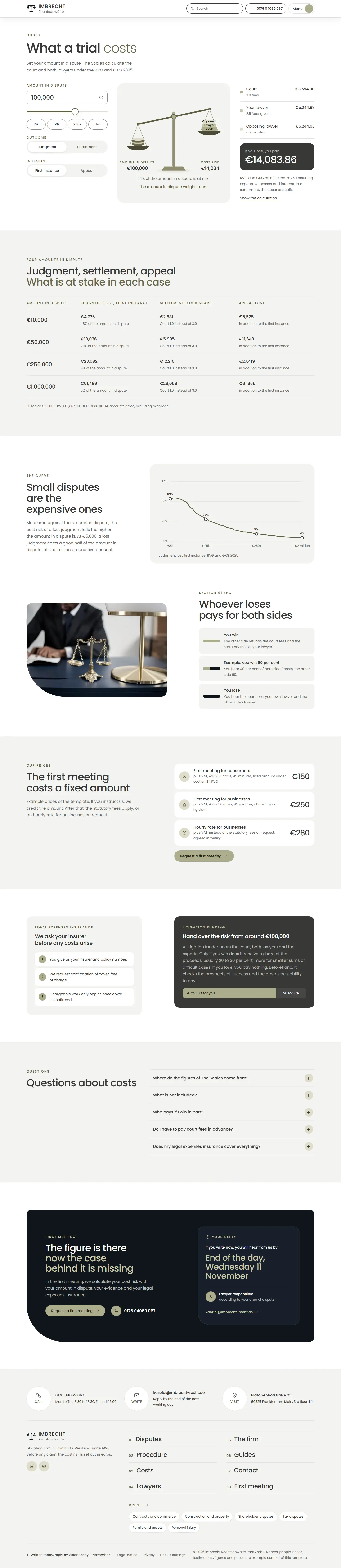
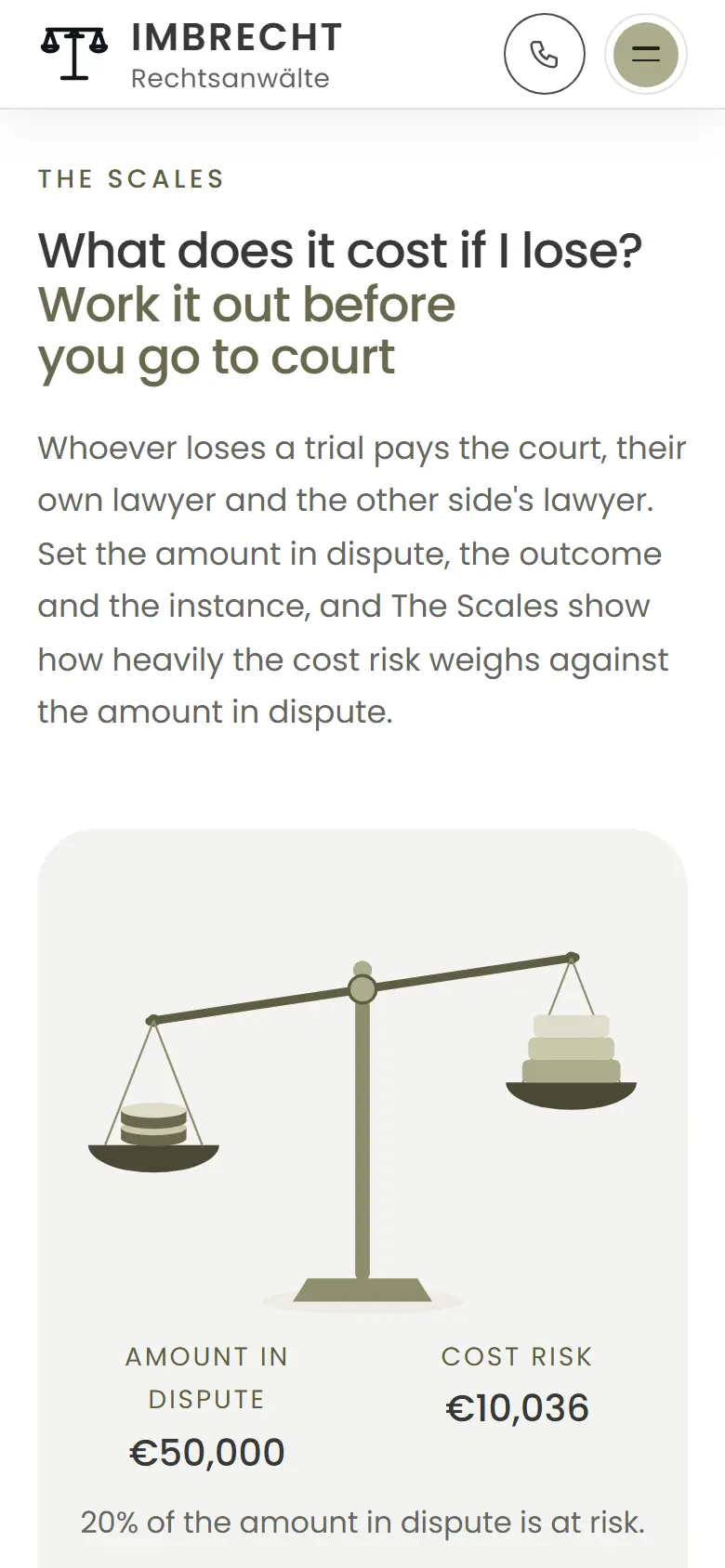
You set the amount in dispute by field, slider or quick choice, plus judgment or settlement and first instance or appeal. After every input The Scales calculate the court, your lawyer and the opposing lawyer, the beam tilts, the pans show amount in dispute and cost risk, and below them stand the share of the amount in dispute, a sentence on which side weighs more and the total line. With reduced motion they jump to the new state without a transition.
From src/lib/kosten.ts. It holds the fee tables of section 13 RVG and section 34 GKG as amended by the KostBRÄG 2025, in force since 1 June 2025, plus the rates for the procedural fee, hearing fee, settlement fee, appeal, flat rate for expenses and VAT. The tables are checked against the wording of the statute, and twenty-five hand-calculated reference values match to the cent. Experts, witnesses, interest and enforcement are explicitly not included.
Then your AI changes one file. Home page, costs page, The Scales on the areas of dispute, the table without scripts, the bars per area and the quick calculation in the closing section all read from src/lib/kosten.ts and follow. Only the few sentences that name an amount in the text are checked by hand afterwards.
No. The Scales calculate the statutory fees for an assumed amount in dispute and say so on the page. Whether a claim has prospects, which amount in dispute applies and which expenses come on top is settled in the first meeting. The articles say in the same spirit that they do not replace advice on the individual case.
The template advertises factually in line with section 43b BRAO and section 6 BORA, the German professional rules for lawyers. Certified specialist titles are named as in the FAO, at most two per person, the word specialist is not used otherwise, and no sentence promises an outcome. Cases carry the note that every case is different, testimonials are marked as example testimonials and published only with written consent, and the settlement rate appears everywhere as an example value. Checking the finished site remains with you, and these notes are not legal advice.
They are checked against German law as of October 2026, among them the statutory deadline after a claim is served, the objection to a court payment order, the appeal, the new threshold between Local Court and Regional Court since 1 January 2026, the objection to a tax assessment with notification on the fourth day, limitation in personal injury with its suspensions and limitation of the equalisation of accrued gains. Before going live it is worth checking whether a figure has changed.
Because a deadline entered wrongly does more harm than one explained well. Tax disputes and personal injury therefore carry deadline cards with start, provision and a dated example, and on the guides page you choose your post and get the first deadline and the matching article. If you want a calculator, Treuwald has one.
All three are law firm sites with practice areas, team and contact. Nordhelm builds the site around being reachable in an emergency, with an emergency page and emergency band. Treuwald lets clients work out their own deadline. Imbrecht is built for a firm that only takes contentious cases, does the maths on the cost risk with The Scales before the claim and shows the way through a trial stage by stage, light in white, khaki and night blue.
Yes. Each area is an entry in src/data/streitfelder.ts with responsibility, example amount, deadline and short text, and the building blocks of the area pages live in src/data/module.ts. From them come the card, the rows in the overview tables and the menu entry. A new area such as inheritance disputes is set up by your AI with the structure of the others, including The Scales, documents and questions.
No. The firm promises a reply by the end of the next working day and is closed at weekends. The display “If you write now, you will hear from us by …” works out the day with weekends and the public holidays of Hesse from src/lib/frist.ts, and without scripts a fixed sentence stands there. If your firm is in another German state, your AI adjusts the holidays. Only promise on the site what you really keep.
Firm, people, testimonials, assessment and page titles live in src/data/site.ts, the areas of dispute in src/data/streitfelder.ts, the texts of the home and firm pages in src/data/seiten.ts, the articles with deadlines and glossary in src/data/wissen.ts. Each person has a role, certified specialist titles, year of admission, area of dispute, initials, email and one sentence. The matrix on the lawyers page sets the lead and the deputy for every area. The start skill goes through the details in rounds.
No. Firm, people, careers, cases, testimonials, key figures, settlement rate, duration and prices are invented. The site says so in place, below the key figures, on every testimonial and case, on the costs and lawyers pages and in the footer of every page. Platanenhofstraße does not exist, the phone number comes from the block the Federal Network Agency keeps free for media, and the name Imbrecht is checked against trademark registers and domains. Frankfurt am Main appears as the real city.
Strangers in sample photos from Pexels. The founder shows the same model in two shots of one series, and no model release exists for it. The other four lawyers therefore appear as initials and the testimonials without faces. Before going live you replace the founder photo with your own portrait and add your own team photos taken with consent, the initials show where they belong.
The 24 photos come from Pexels, may be used commercially and share one colour grade. They show no real law firm. src/data/bildnachweis.json names the photographer, source and licence for every image, and the legal notice lists the credits. On the tax disputes photo the brand lettering of the calculator has been removed. The Scales, the cost curve, the courtroom plan, the monthly calendar and the route sketch are drawings of the template itself.
As instructions, not as pre-written legal texts, and marked noindex. The legal notice says what a German law firm has to state, from provider, representation and partnership register through professional title, responsible bar association and professional regulations to professional indemnity insurance and dispute resolution. Below it stand the image credits. The privacy policy describes what the website does technically. These notes are not legal advice.
The contact form asks for the area of dispute, whether a deadline is running and until when, the rough size of the dispute and name, phone, email and a sentence or two on the case. It checks the fields, marks errors right at the field and then shows a confirmation with the note that the template sends nothing. Your AI sets up the sending and adds it to the privacy policy. Because enquiries to a law firm fall under professional confidentiality, a route that transmits the message encrypted is worth it.
No. Poppins lives in public/fonts/, the photos in the project, The Scales, the curve and the route sketch are drawn, and no map is embedded. The cookie dialog writes the choice to the dataLayer, and statistics and external media are not tied to any service.
Yes. Every page has its own title, description and breadcrumb, plus structured data as LegalService and Attorney with address, office hours and people, without ratings. The pages add Service, FAQPage, Article and ContactPage. The articles target searches such as a claim being served, the objection to a tax assessment or the loss of housekeeping capacity. Astro builds the share images at 1200 by 630 pixels from a photo of each page.
Yes. Every heading and every text is there without scripts. The Scales then show a table for four amounts in dispute with judgment, settlement and appeal, the questions are expanded, the tabs stand one below the other, the guides page shows all articles and all six deadlines of the choice of post, and the menu opens as well. Your own amounts, the accrued gains calculator, filters and search need JavaScript.
Formally throughout in German, which the English version renders as a plain “you”, and the firm speaks as we. The sentences of the components and scripts live in src/data/texte.ts, the remaining texts in the data files and pages. Your AI switches to the informal form if your clients expect it.
Three fixed example prices, separate for consumers and businesses, plus an hourly rate for businesses. The amount for consumers is a fixed amount under section 34 RVG below the cap for a first consultation without an agreement and is credited if you instruct the firm. Your AI puts in your own prices and checks that the figure reads the same everywhere.
Yes. Your AI removes the other areas and gives the one more room, while The Scales, the trial in eight stages and the costs page stay. A firm that advises and drafts rather than litigates will find the better fit among the other templates in the law category.
Anywhere static files may live. Astro builds the site into a folder of finished HTML that you upload to your host. Beforehand your AI sets your own domain in astro.config.mjs and in robots.txt.
Yes. Pay once, yours for good, for your own projects and client projects. You get the complete source code without a watermark.
Yes. In the English package the whole website is in British English, with an English knowledge layer and English skills. The calculator is called “The Scales” there. Fees, deadlines and statutes remain German law, because the firm is based in Frankfurt.
No. You tell your AI in the project folder what should change, and it finds the place through CLAUDE.md and the seven skills. If you want to work on it yourself, you will find firm and people in src/data/site.ts, the areas of dispute in src/data/streitfelder.ts and the fees in src/lib/kosten.ts.
 New in the marketplace
The law firm website that shows in three questions who at the firm takes on the case.
 New in the marketplace
The inheritance law firm whose rings show who inherits without a will and how much compulsory portion is left.
 New in the marketplace
Criminal defence with a speeding fine check that works out the fine, points and driving ban after every input.

The law firm website that lets clients calculate their deadline.
We would like to understand how this site is used with Google Analytics, loaded via Google Tag Manager. Nothing loads and no cookie is set before your ok. You can change your choice anytime in the privacy policy.
Choose what may be active. You can change your selection anytime in the privacy policy.