Seven skills
You write what you want. Your AI knows how
- start
- template-aufbau
- copywriting
- design-system
- seo
- qualitaetspruefung
- systemwissen
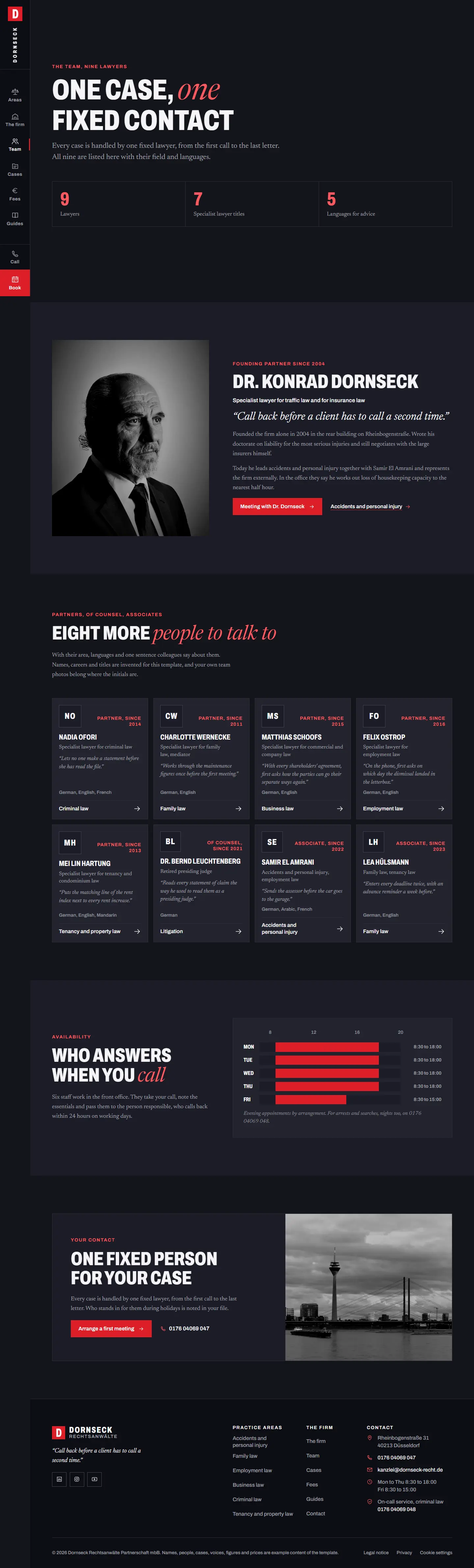
The law firm that shows before the call who takes on the case

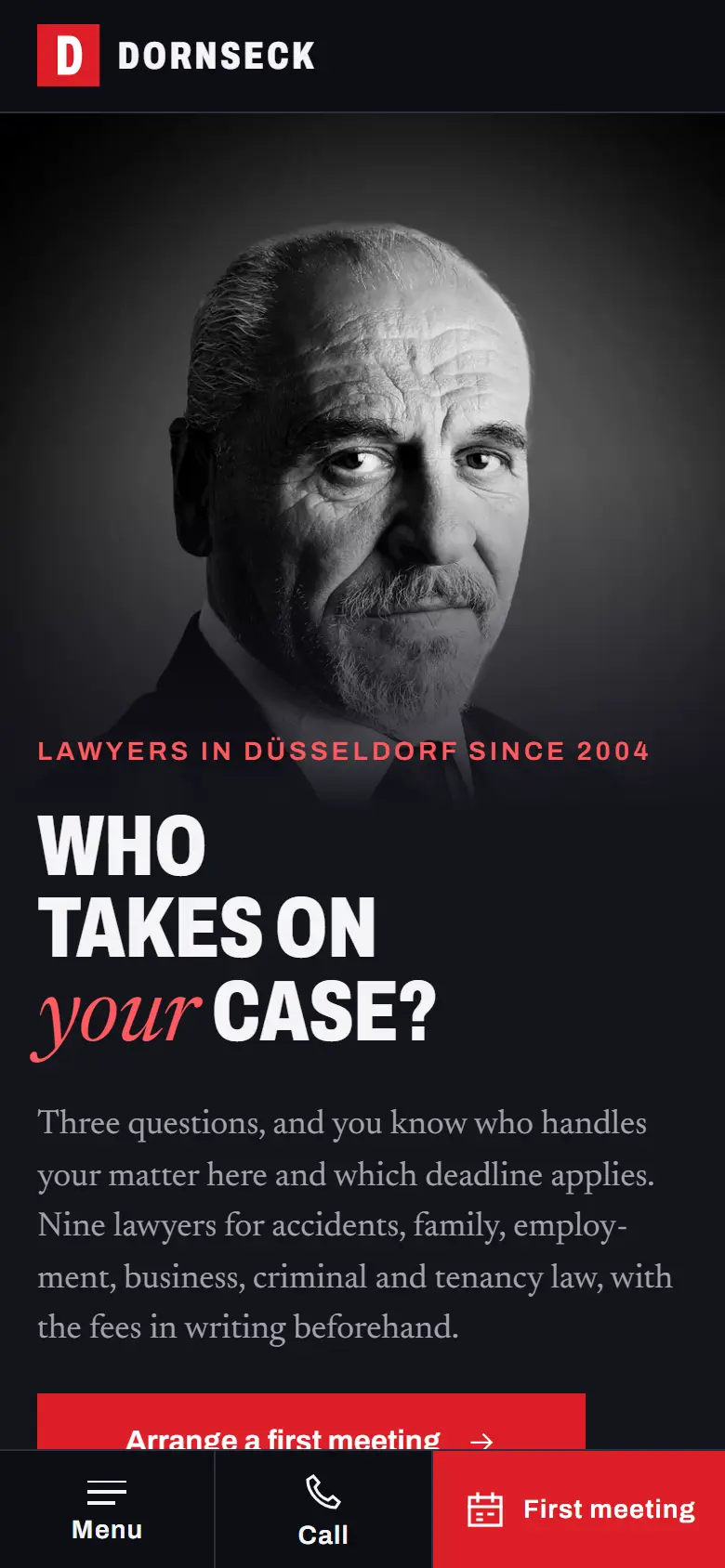
Narrow capitals, one italic word, the founder in a suit
Greyscale image cards, each with its deadline
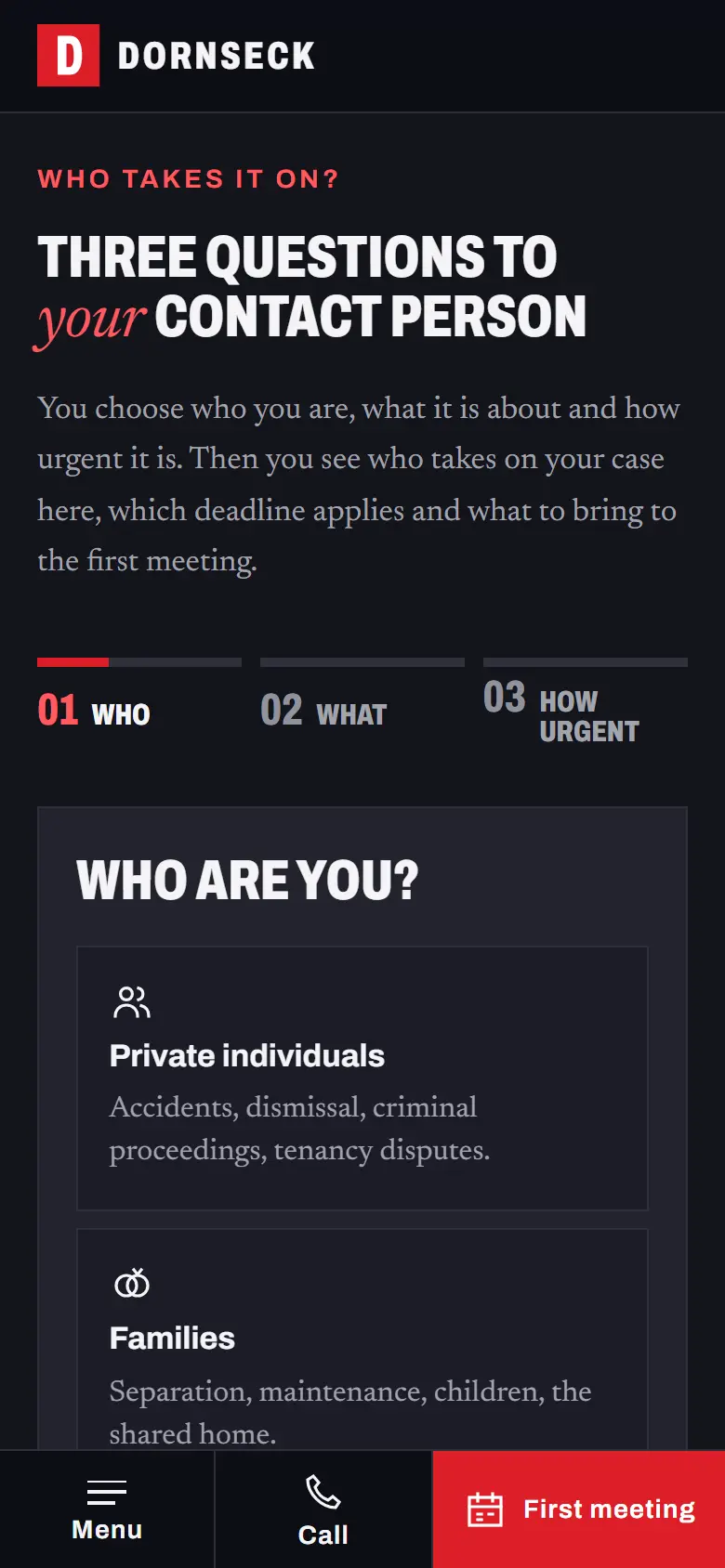
Three questions, then the right person lights up
The founder’s guiding sentence and three commitments
Three bars as sample values, three testimonials
Three guides with author, then the first meeting




You write what you want. Your AI knows how
The rules of the template for your AI
Not just squeezed together
Strategy and blueprint in the project
Switched to your brand in one sentence
Firms with fixed responsibilities per practice area
Partnerships serving consumers and small businesses
Agencies that deliver law firm websites reliably
Secure payment via Stripe, the ZIP arrives right after
Rather have it done for you?AI Website Service · €899First steps in the docs Template, service and custom pricing compared
The home page asks three questions. First, who is asking, an individual, a family or a business. Then, what it is about, with four matters per group in everyday language, from “I’ve been dismissed” to “Search at the business”. Finally, how urgent it is. After the first answer the people responsible for the group step forward in the team, after the second one person lights up, and at the end the name, practice area, deadline and what to bring to the first meeting appear, with a button to get in touch.
From src/data/gebiete.ts. Each matter there names the person, the practice area, the deadline, a sentence for urgent cases and the documents. Changing a responsibility means changing one line, and the tool, its table without scripts and the matters on the practice areas overview follow. If someone asks for help today in criminal law, the result shows the on-call number instead of the office number.
No. It says who at the firm is responsible, which deadline usually applies and what to bring to the first meeting. Whether the deadline runs that way in an individual case is settled in the meeting. The guides say in the same spirit that they do not replace advice on an individual case, and a deadline calculator is deliberately not built in.
The template advertises factually in line with § 43b BRAO and § 6 BORA, the German professional rules for lawyers. Specialist lawyer titles appear only where they are held, the word specialist is not used otherwise, and no sentence promises an outcome. Cases are anonymised and marked as examples, client voices name no outcome and carry the note on consent and release from confidentiality. The copywriting skill lists the limits for rewriting. Checking the finished site remains with you, and these notes are not legal advice.
They are checked against German law as of October 2026, among them the unfair dismissal claim under § 4 KSchG, the objection to a penalty order under § 410 StPO, the objection to a court payment order, the service charge statement, challenging owners’ resolutions under § 45 WEG, the separation year and the limitation period after an accident. The initial consultation appears with the cap under § 34 RVG, which applies to consumers only. Before going live it is worth checking whether a figure has changed, such as the rent cap in your city.
All three are law firm sites with practice areas, team and contact. Nordhelm builds the site around being reachable in an emergency, with an emergency page and an emergency band. Treuwald lets clients calculate their deadline. Dornseck leads to the responsible person in three questions, shows a fixed deadline card per practice area instead of a calculator and carries six areas with nine lawyers, in near black with signal red.
Yes. Each area is an entry in src/data/gebiete.ts, and from it come the page, the card, the row in the comparison table and the menu entry. Your AI adds a new area such as inheritance law in the structure of the others, with deadline, fees, services, contact person and questions, and adds its matters to “Who takes it on?”. The small tools of the areas are separate components that simply go when an area is removed.
Yes. The on-call service appears as a calm line of text on the criminal law page, in “Who takes it on?”, on the team page, in contact and in the footer, not as an alarm band. Without it your AI removes the number, and “Who takes it on?” shows the office number even for urgent cases. Only promise availability on the site that really exists.
Firm, people, client voices, cases and page titles live in src/data/site.ts, the openings of all pages in src/data/heros.ts, practice areas, matters and deadlines in src/data/gebiete.ts, the guides with the deadline table and glossary in src/data/wissen.ts. Each person has a role, title, area, languages, initials, the year they joined and a sentence from colleagues. Enter specialist lawyer titles exactly as the bar association awarded them. The start skill goes through the details in rounds.
No. Firm, people, cases, client voices, key figures, breakdown and prices are invented. The site says so where they appear, below the key figures, on every voice and case, below the breakdown, on the fees page, in the team and in the footer of every page. Rheinbogenstraße does not exist, the phone numbers come from the block the German Federal Network Agency keeps free for media use, and the name Dornseck has been checked against trademark registers and domains. Düsseldorf stands as the real city.
Strangers in sample photos from Pexels. The founder shows the same model throughout, from one photo series, and there is no model release for it. That is why the other eight people appear as initials and the client voices without faces. Before going live you replace the founder photo with your own portrait and add your own team photos taken with consent, the initials show where they belong.
The 28 photos come from Pexels, may be used commercially and share one greyscale treatment. They do not show a real law firm. src/data/bildnachweis.json names the photographer, source and licence of each image, and the legal notice lists the credits. The fee statement, the rent cap bars, the deadline axis and the directions are drawings of the template itself.
As instructions, not as pre-written legal texts, and marked noindex. The legal notice says what a law firm in Germany has to state, from the provider and partnership register through professional title, the competent bar association and professional rules to professional indemnity insurance and consumer dispute resolution. Below it are the photo credits. The privacy page describes what the website does technically. These notes are not legal advice.
The contact form asks in three steps for the matter, a description with deadline and urgency and the call back number, checks each step and marks errors right at the field. Then it shows a confirmation, nothing is sent yet. Your AI sets up the sending and adds it to the privacy policy. Because enquiries to a law firm are often confidential, a route that transmits the message encrypted is worth choosing.
No. Archivo and Newsreader live in public/fonts/, the photos in the project, directions and graphics are drawn, and no map is embedded. The cookie banner writes the choice to the dataLayer, statistics and external media are not tied to any service.
Yes. Every page has its own title, description and breadcrumbs, plus structured data as LegalService and Attorney with address, office hours and people, without ratings. The pages add Service, FAQPage, Article, ContactPage and a glossary as DefinedTermSet. The guides target search questions such as the deadline against a dismissal or the objection to a penalty order. Astro builds the share images at 1200 by 630 pixels at build time from a photo of each page.
Yes. Every heading and every text is there without scripts. “Who takes it on?” then shows a table per group with matter, responsible person and deadline, the questions are expanded, the four legal forms stand one below the other, the contact form shows all three steps, and the phone menu opens too. Severance pay and rent cap show a worked example. Filters, search, the offer check and working out your own figures need JavaScript.
Formally throughout in German, which the English version renders as a plain “you”, and the firm speaks as we. The sentences of the components and scripts live in src/data/texte.ts, the openings of all pages in src/data/heros.ts, the remaining texts in the data files and pages. Your AI switches to the informal form if your clients expect it.
The structure does. Practice areas become service areas, “Who takes it on?” becomes a mapping from matters to people, and the fees page carries any fee schedule. For a firm with one area your AI removes the other pages and lets the tool choose between the matters of that area. Notaries have their own advertising and disclosure rules, which belong in the copywriting skill.
Anywhere static files may live. Astro builds the site into a folder of finished HTML that you upload to your host. Before that your AI sets your own domain in astro.config.mjs and in robots.txt.
Yes. Pay once, yours for good, for your own projects and client projects. You get the complete source code without a watermark.
Yes. In the English package the whole website is in English, in British spelling, with an English knowledge layer and English skills. Legal terms and statutes remain German law, because the firm is based in Düsseldorf.
No. You tell your AI in the project folder what should change, and it finds the place through CLAUDE.md and the seven skills. If you want to edit things yourself, you will find the firm and people in src/data/site.ts and practice areas, matters and deadlines in src/data/gebiete.ts.
 New in the marketplace
The website for litigation firms whose Scales show before the claim what a lost trial costs.
 New in the marketplace
The inheritance law firm whose rings show who inherits without a will and how much compulsory portion is left.
 New in the marketplace
Criminal defence with a speeding fine check that works out the fine, points and driving ban after every input.

The law firm website that lets clients calculate their deadline.
We would like to understand how this site is used with Google Analytics, loaded via Google Tag Manager. Nothing loads and no cookie is set before your ok. You can change your choice anytime in the privacy policy.
Choose what may be active. You can change your selection anytime in the privacy policy.