Seven skills
You write what you want. Your AI knows how
- start
- template-aufbau
- copywriting
- design-system
- seo
- qualitaetspruefung
- systemwissen
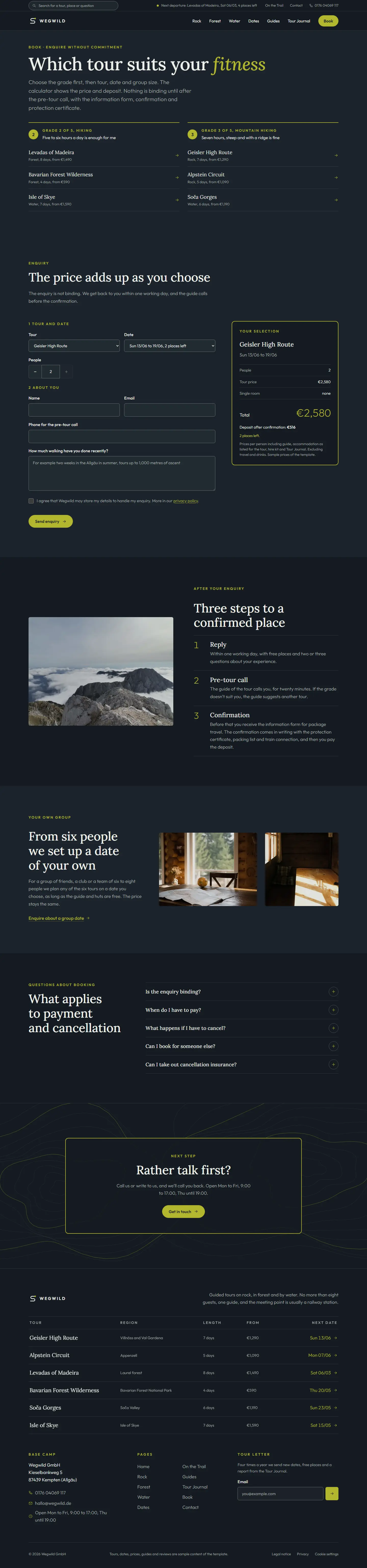
Your guide shows you what you would otherwise miss

The Dolomites at dusk, the word set behind the peaks
Two cards each for Rock, Forest and Water
Eight at most, guides with their own ground, all included
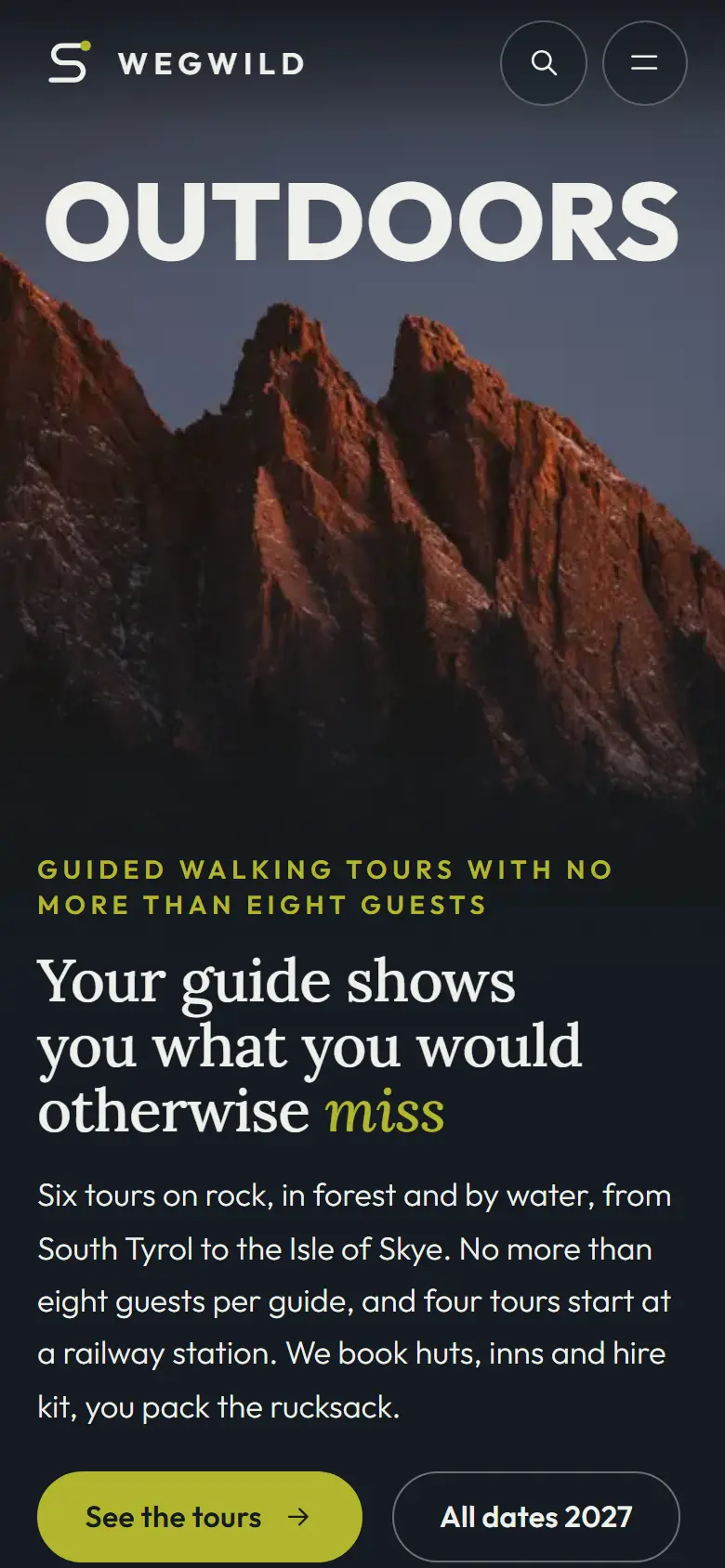
Three points in a spruce forest, the list explains them
Five dates with one dot per place, three guest voices
Four initials, three posts, rock, forest or water





Spots on the part of the picture that matters
What you see there and what it means on tour
Home page plus Rock, Forest and Water
Points in the picture, every note as a list
You write what you want. Your AI knows how
The rules of the template for your AI
Not just squeezed together
Strategy and blueprint in the project
Switched to your brand in one sentence
Small operators of guided walking and hut tours
Hiking guides and mountain schools with fixed dates
Agencies that deliver tour websites reliably
Secure payment via Stripe, the ZIP arrives right after
Rather have it done for you?AI Website Service · €899First steps in the docs Template, service and custom pricing compared
The signature feature of the template. A landscape photo carries three points at the places a guide shows you on the trail, such as towering clouds over the ridge, a gully with old snow or a pool between boulders. Anyone who taps or clicks a point, or reaches it with Tab and Enter, reads in the list beside it what you see there and what it means for the tour. List and point stay in step, the arrow keys move through the list, and on desktop a label with a line points to the active spot.
On the home page with three spots in a spruce forest and as the opening of each of the three landscape pages Rock, Forest and Water, so twelve spots on four pages. Every spot is one entry with x, y, title and text in src/data/site.ts. The coordinates are percentages of the photo, the photo is never cropped, so a point sits in the same place at every screen width.
Yes. Every heading and every text is there without scripts. The Viewfinder shows its points in the picture and all explanations as a numbered list, the elevation profile is complete, the calculator shows its starting value from the same calculation, the packing list consists of plain checkboxes, the calendar shows every date, tabs stack, questions stay open, and the phone menu still opens.
Funkenmoos is built for glamping sites with tents and trips and works out how dark the night gets. Lauschgrat is for owners of several holiday cabins with a night value in decibels and a price calculator including tourist tax. Kehrwelt sells cycling holidays without flying, with evenings in the city and a journey chain. Wegwild is for guided walking tours in small groups, with tours by landscape, stages and elevation profile, grades, dates with free places and a guide who points out in the photo what you see on the trail.
For every tour the end point or highest point of each day in metres, on the Geisler High Route for example from 1,339 m in the Villnöss valley to 2,475 m at the Puez Hut. The curve is drawn, and values and labels sit below it as text that stays readable on the phone. It is fed from the stages of the tour, so a new stage changes the profile by itself.
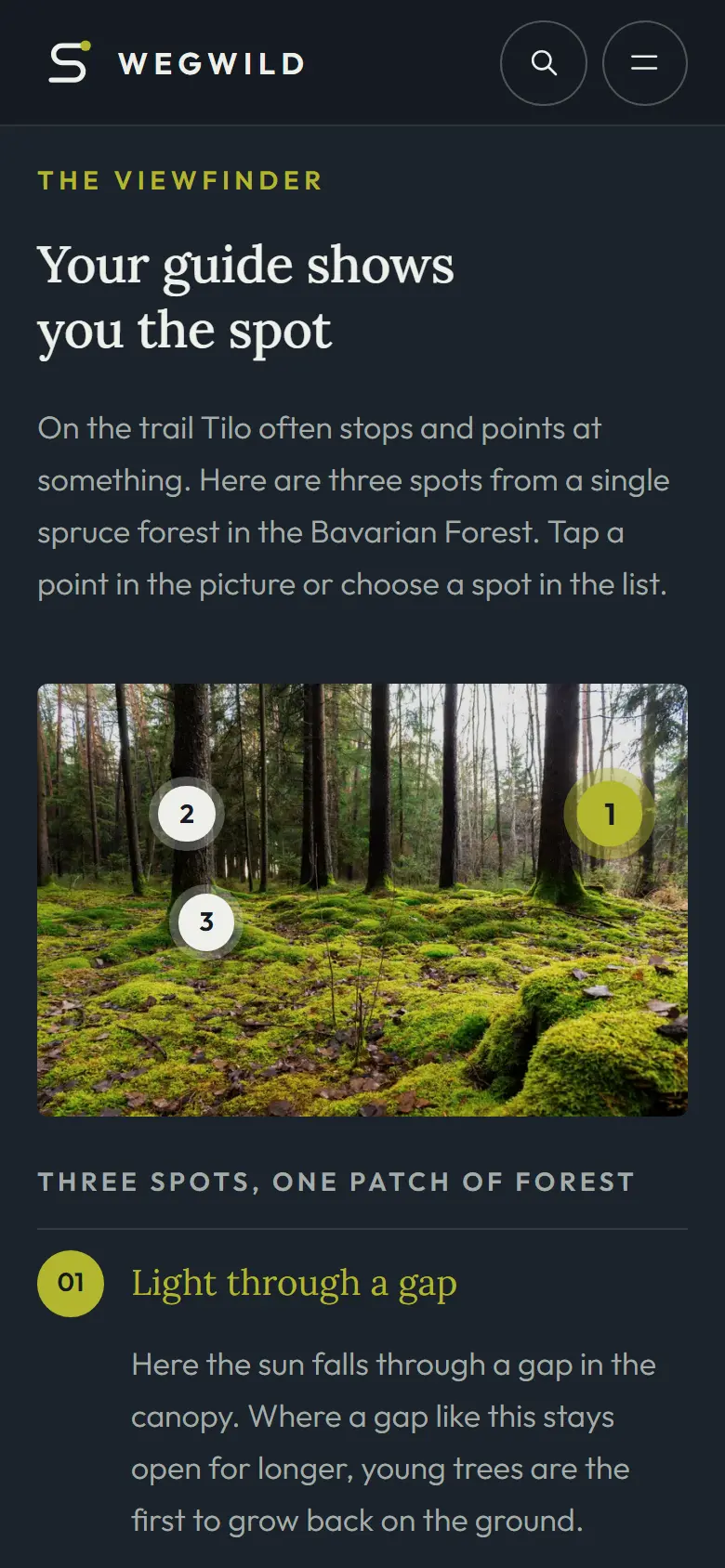
Tour price times people, plus the single room times people if wanted, where the tour offers one, so €260 on Madeira, €180 on the Soča and €240 on Skye. The deposit is 20 per cent of the total. The starting value is two people on the Geisler High Route, so €2,580 and a €516 deposit. Fully booked dates are marked, you cannot pick more people than there are free places, and ?tour=soca in the address preselects the tour. The rule lives once in src/lib/rechner.ts, and the value without scripts comes from there too.
The On the Trail page lists five grades from a walk with some climbing to a high alpine tour, with hours, ascent and a comparison with the Swiss hiking scale. Choosing a grade shows the matching tours, and grades 4 and 5 say honestly that there are none. The packing list has 20 items in four groups, including what the operator lends you, and remembers its ticks in the browser, not on a server.
Tours over several days with accommodation and guiding are usually package travel under German law, and the template is built for that. Book and Dates name the standard information form and the protection certificate before the deposit, a 20 per cent deposit, the balance 30 days before the start, cancellation tiers with the note on lower actual loss, withdrawal in extraordinary circumstances and a replacement. The legal notice explains package travel, financial protection and guiding abroad. Check your own terms before going live, these notes are no legal advice.
All 41 sample dates are listed by month from March to November, each with its free places or marked as fully booked. Filters choose the landscape, one month and dates with free places only, if nothing fits a sentence points to private group dates, and a button resets everything. The page works out the number of dates and free places from the data, it is never typed in by hand.
Every date sits with its free places under its tour in src/data/site.ts, the season year once as saison. The dates are fixed samples for 2027 and age, so when you adapt the site your AI puts in your real dates. The edition of the Tour Journal comes from the newest post, the year in the footer from the build date.
With one entry under touren in src/data/site.ts, with landscape, region, days, distance, ascent, grade, highest point, accommodation, price, single room, guide, meeting point, stages and dates. From that come the section on the landscape page with elevation profile, the tour card, the dates in the calendar and the entries in the calculator, the search and the footer. The alt texts of the images are in src/data/alt.ts.
No, there is no booking system built in. The Book page collects a non binding enquiry with tour, date, group size and single room, then the guide holds a pre-tour call, and the booking follows with standard information form, confirmation and protection certificate. If you use a booking system, your AI adds its link or embed to the form and buttons and adds it to the privacy policy and the consent dialog.
Enquiry, contact and Tour Letter check their required fields and the privacy checkbox, mark errors at the field, and the message disappears as you type. Then a confirmation appears, with the first name on enquiry and contact. Nothing is sent in the process. The forms use method="post", and your AI sets up delivery.
It finds tours, landscapes and pages as you type, works with the arrow keys and Enter and shows a sentence when nothing fits. On the phone the magnifier opens the menu with the search field. The index is built from the same data as the pages, so a new tour can be found straight away.
Yes, with some adapting. Landscapes, stages, elevation profile, dates and calculator carry any guided tour over several days, such as snowshoeing, canoeing or pilgrimage. Your AI renames landscapes and grades and rewrites the spots in the Viewfinder. For cycling holidays with cities Kehrwelt is closer, and glacier tours with rope need safety texts of their own.
No. Operator, guides, prices, dates and testimonials are made up, and the footer of every page says so. The address in Kempten is an example, and the phone number comes from the range the German Federal Network Agency reserves for media. Regions, paths, peaks, stations and public huts on the route such as the Geisler peaks, the Säntis, the Levada do Caldeirão Verde, the Grosser Rachel, Lake Krn or the Quiraing are real, businesses and lodgings are not named.
They have been checked and explain what you really see at that place in the photo, without trail myths such as the moss compass. The photos do not show exactly the paths described, though. If you use your own photos, you write your own spots and place the points again, every spot is one entry in src/data/site.ts.
The 65 photos come from Pexels and are under the Pexels licence, none is AI generated, and for the opening the summit line of one is cut out. They show neither the tours described nor the guides. People appear in 17 photos, none with a recognisable face, and there is no model release. src/data/bildnachweis.json and the legal notice name the photographer for every image, the file also lists source and licence.
Because no stock photo should stand next to a real name. Moritz, Vroni, Tilo and Kaja appear as initial plaques with their own ground, background and a line of their own, and the note below says that photos of your own team belong there. Guest testimonials have no faces and are marked as sample voices.
No. Lora and Outfit live in public/fonts/, the photos in the project, and the mark, elevation profile and icons are drawn. The browser runs its own JavaScript without a library, around 6 KB gzipped. The cookie dialog with three equal buttons writes the choice to the dataLayer, statistics and marketing are not connected to any service.
Yes. Every page has its own title, description and breadcrumbs, plus a TravelAgency schema with address and opening hours. Every tour carries TouristTrip with stages and offer, the landscape pages, On the Trail, Book and Contact carry FAQPage, Contact also ContactPage, and the posts BlogPosting. Astro builds the share images at 1200 by 630 pixels from a photo of each page. Legal notice, privacy and 404 are set to noindex and left out of the sitemap.
Informally throughout, and the operator speaks as we. The sentences of the scripts are in src/data/texte.ts, the openings of the pages in src/data/heros.ts, tours, landscapes, guides and questions in src/data/site.ts and the posts in src/data/tourenbuch.ts. Your AI switches to a formal tone if your company prefers it.
Yes. In the English package the whole website is in English, with an English knowledge layer and English skills. The scripts format numbers, euros and dates through the browser in the language of the page.
Anywhere that serves static files. Astro builds the site into a folder of finished HTML that you upload to your host. Before that your AI sets your own domain in astro.config.mjs and robots.txt, and the website derives every other address from it.
Yes. Pay once and it is yours forever, for your own projects and client projects. You get the complete source code with no watermark.
No. You tell your AI in the project folder what should change, and it finds the right place through CLAUDE.md and the seven skills. If you want to work by hand, tours, stages, dates, prices and spots are in src/data/site.ts and the posts in src/data/tourenbuch.ts.
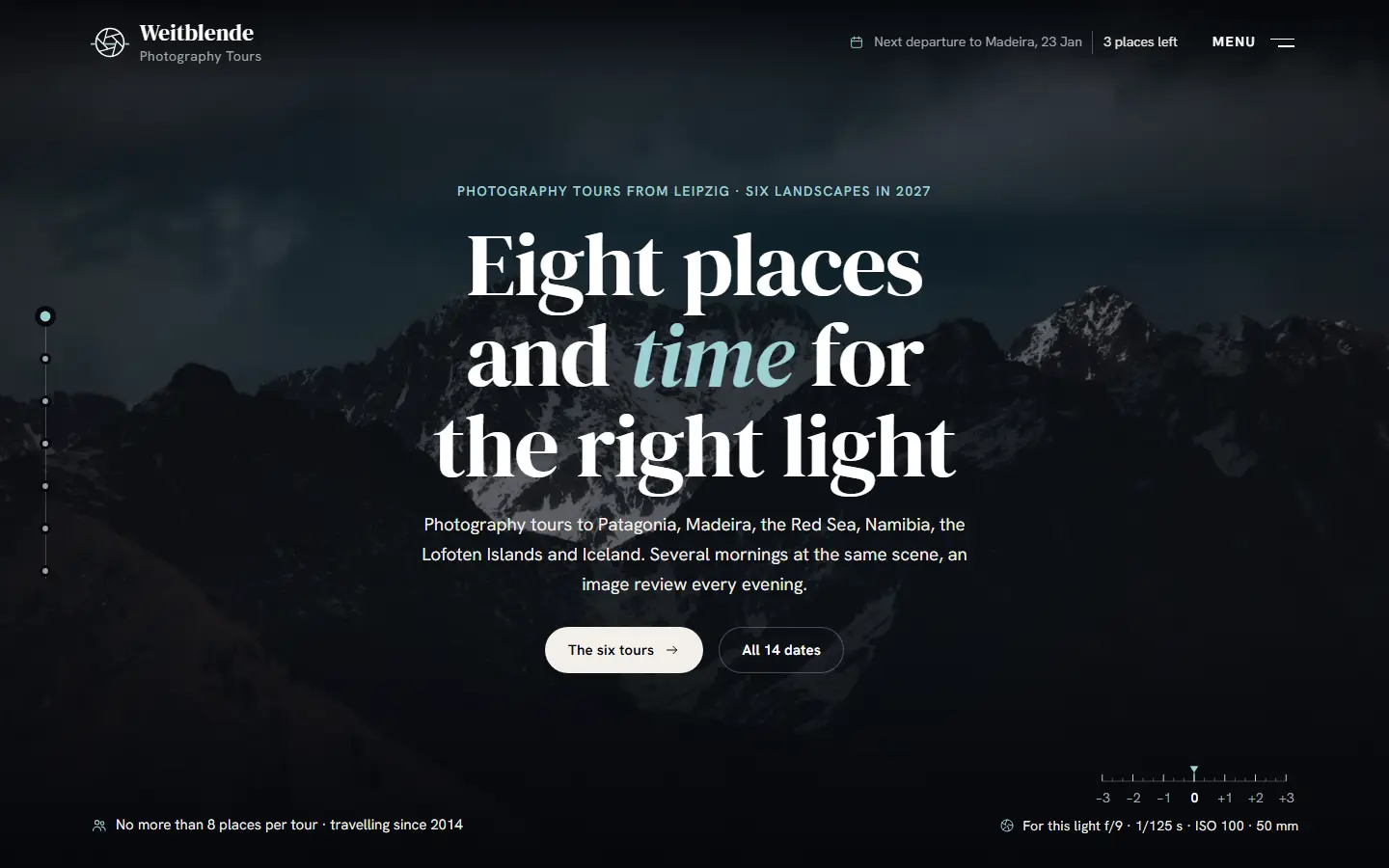 New in the marketplace
The website for photography tours in small groups that shows for every tour when the light comes.
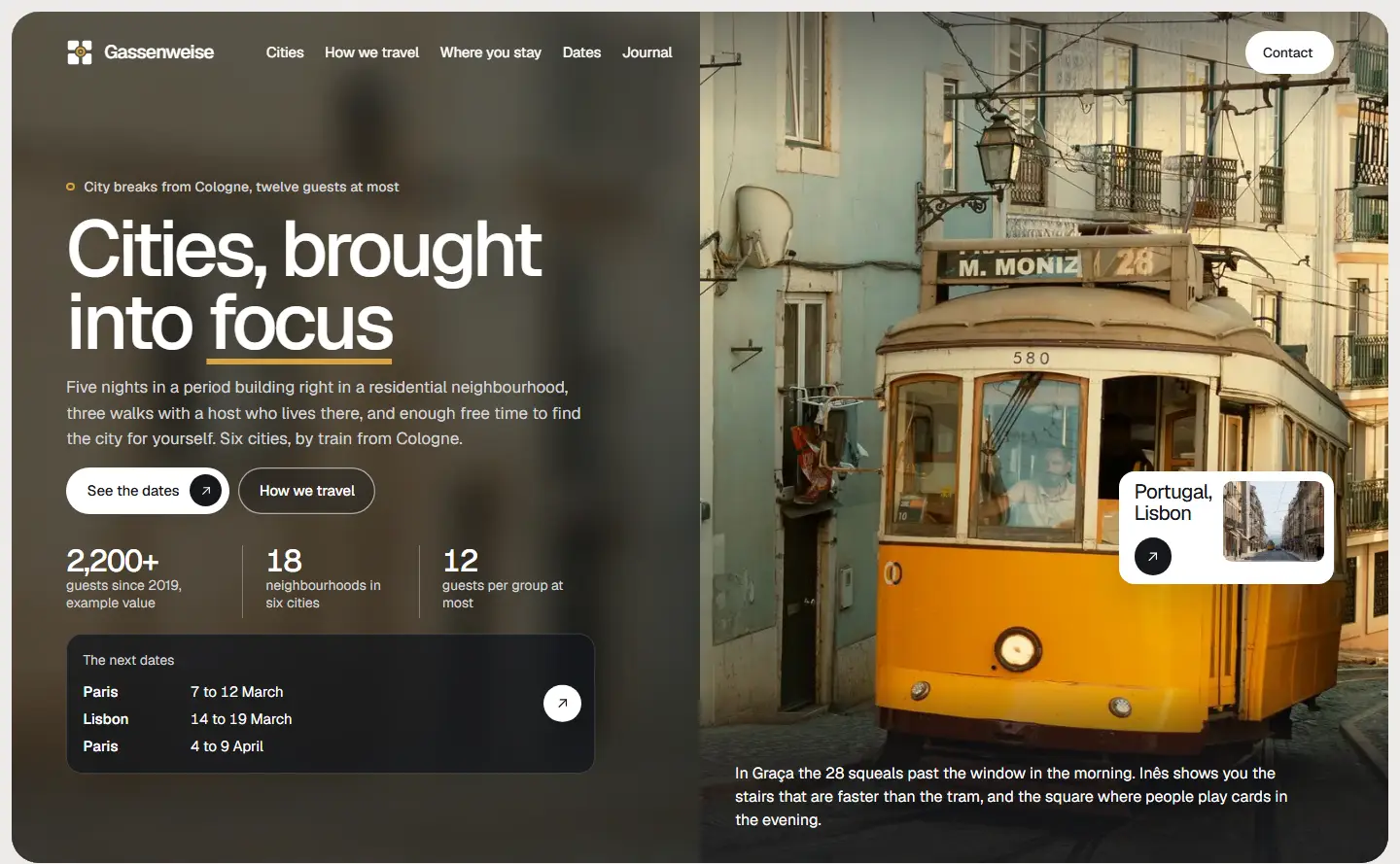 New in the marketplace
The website for city breaks in small groups, with a flat in the neighbourhood and three walks per city.
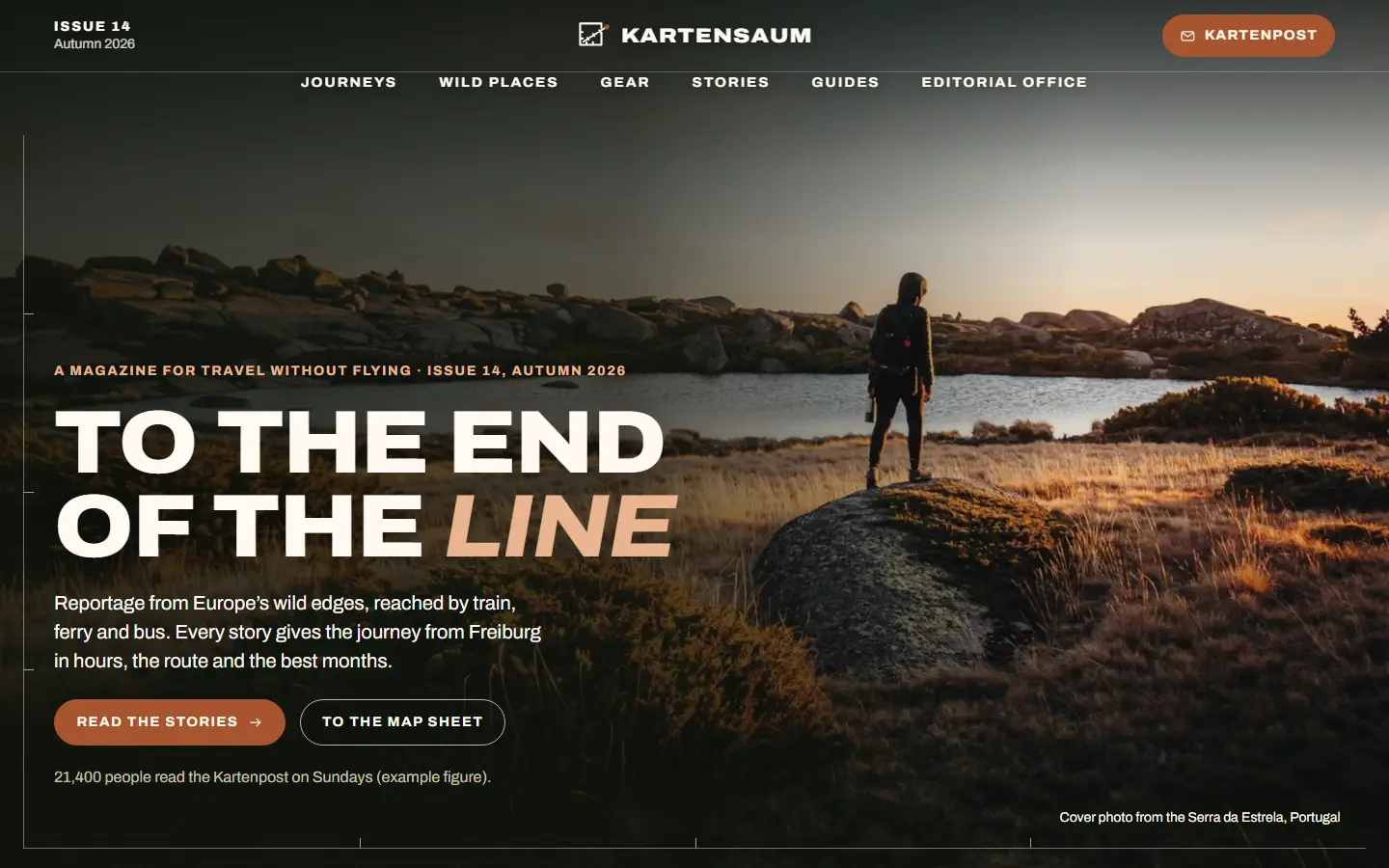 New in the marketplace
The website for travel magazines and blogs that shows the journey to every destination in hours, without flying.
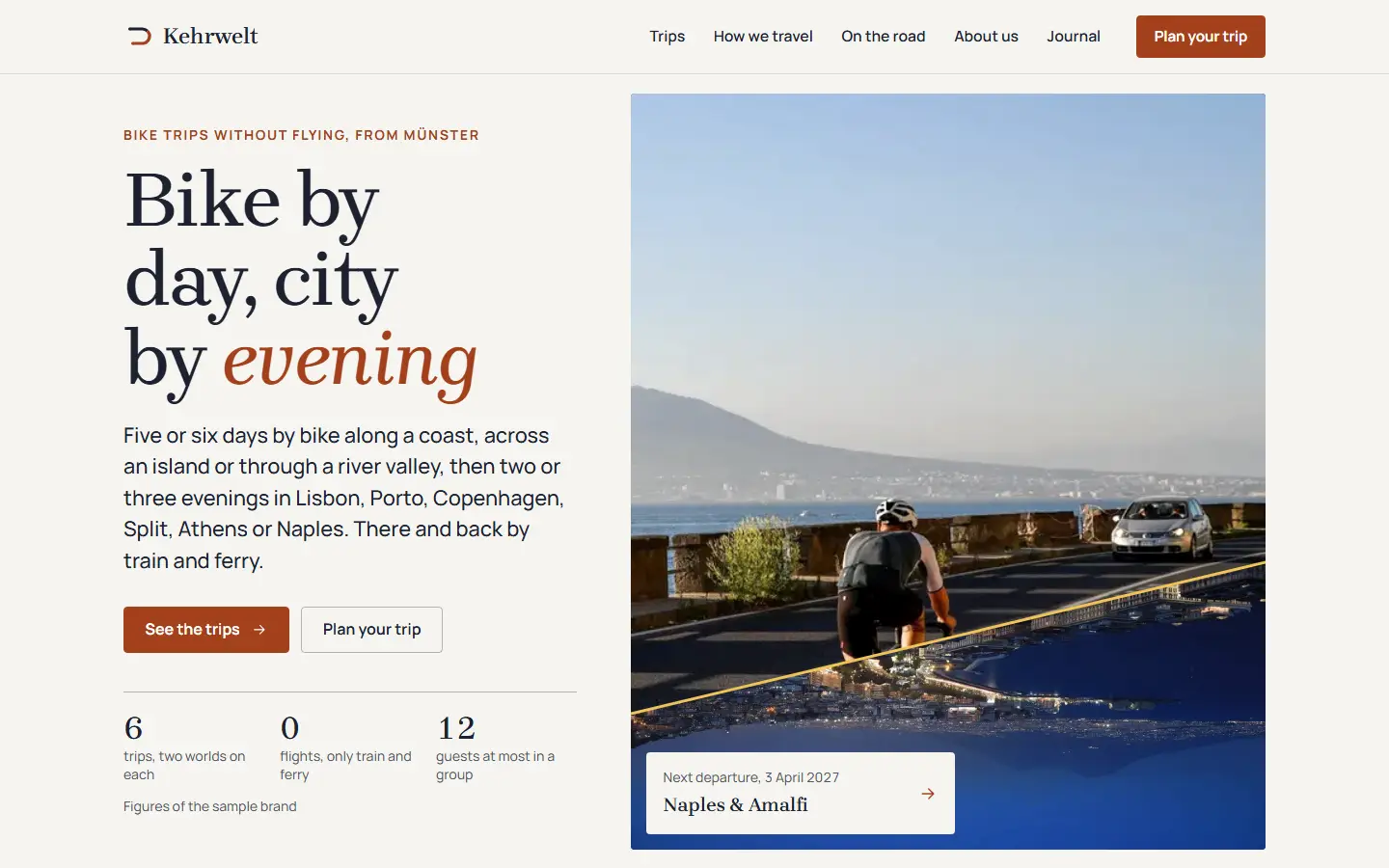 New in the marketplace
The website for cycling holidays without flying, showing every trip as a day on the bike and an evening in the city.
We would like to understand how this site is used with Google Analytics, loaded via Google Tag Manager. Nothing loads and no cookie is set before your ok. You can change your choice anytime in the privacy policy.
Choose what may be active. You can change your selection anytime in the privacy policy.