Seven skills
You write what you want. Your AI knows how
- start
- template-aufbau
- copywriting
- design-system
- seo
- qualitaetspruefung
- systemwissen
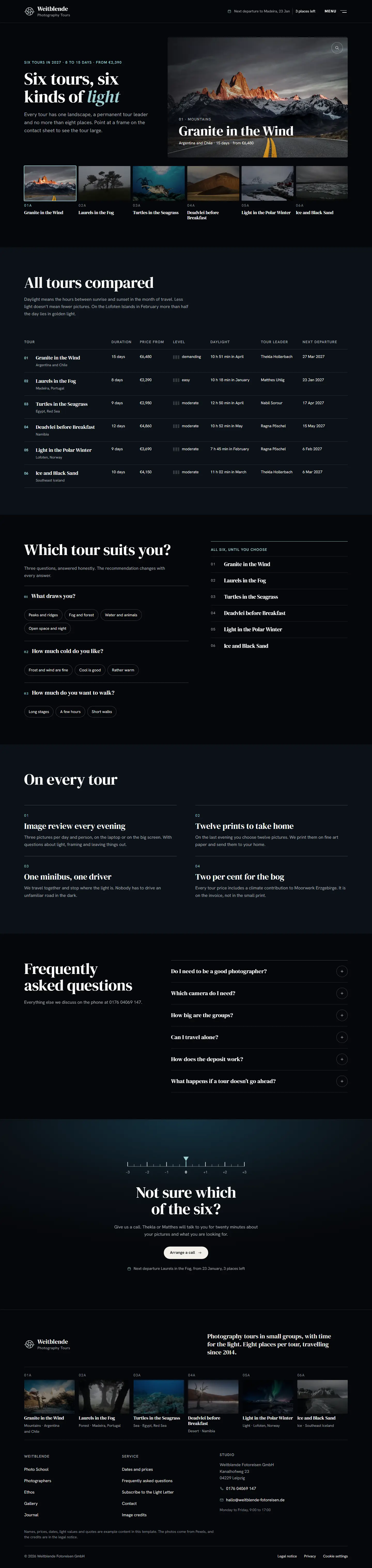
Six photography tours, and each one says when the light comes

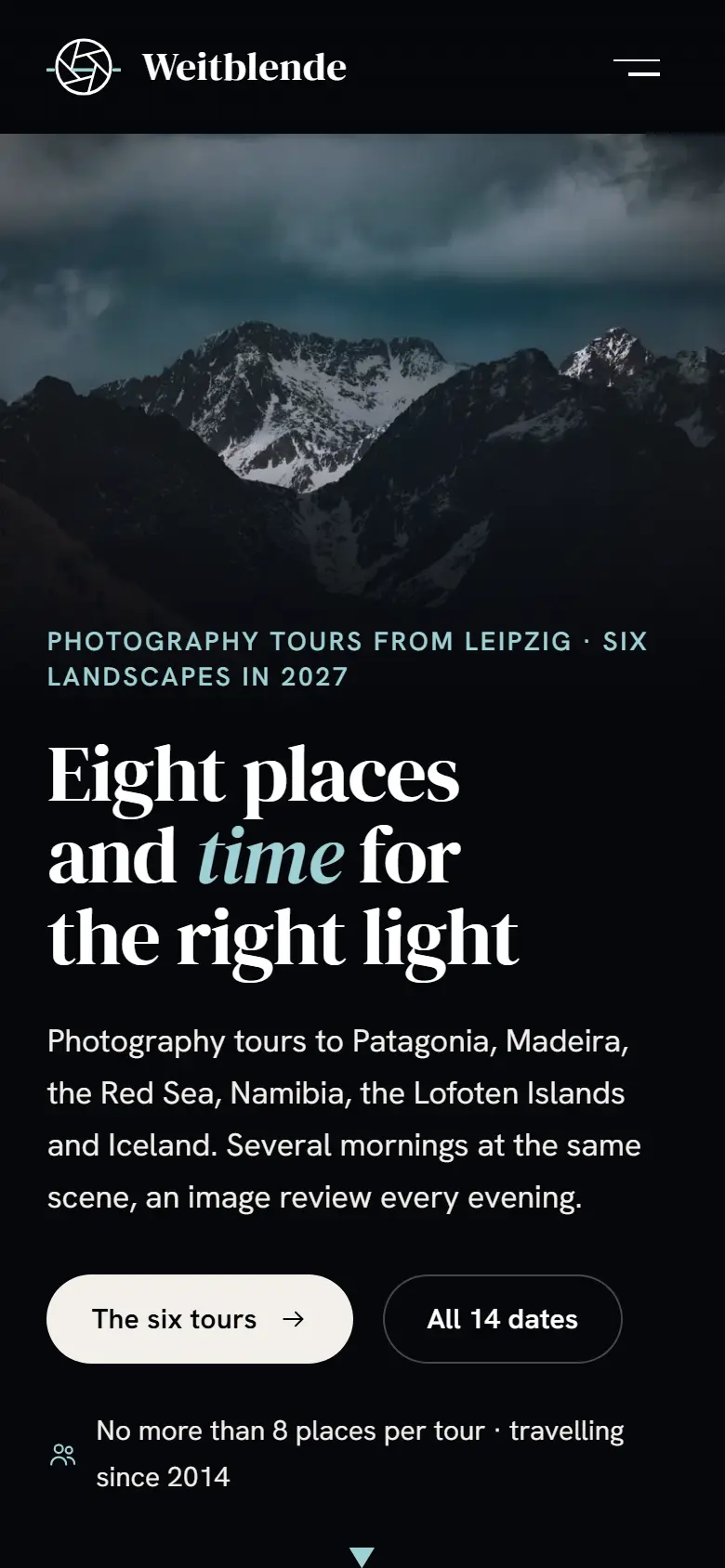
Peak under clouds, one italic word, exposure scale
Each band comes into correct exposure as you scroll
Light before kilometres, eight places, image review
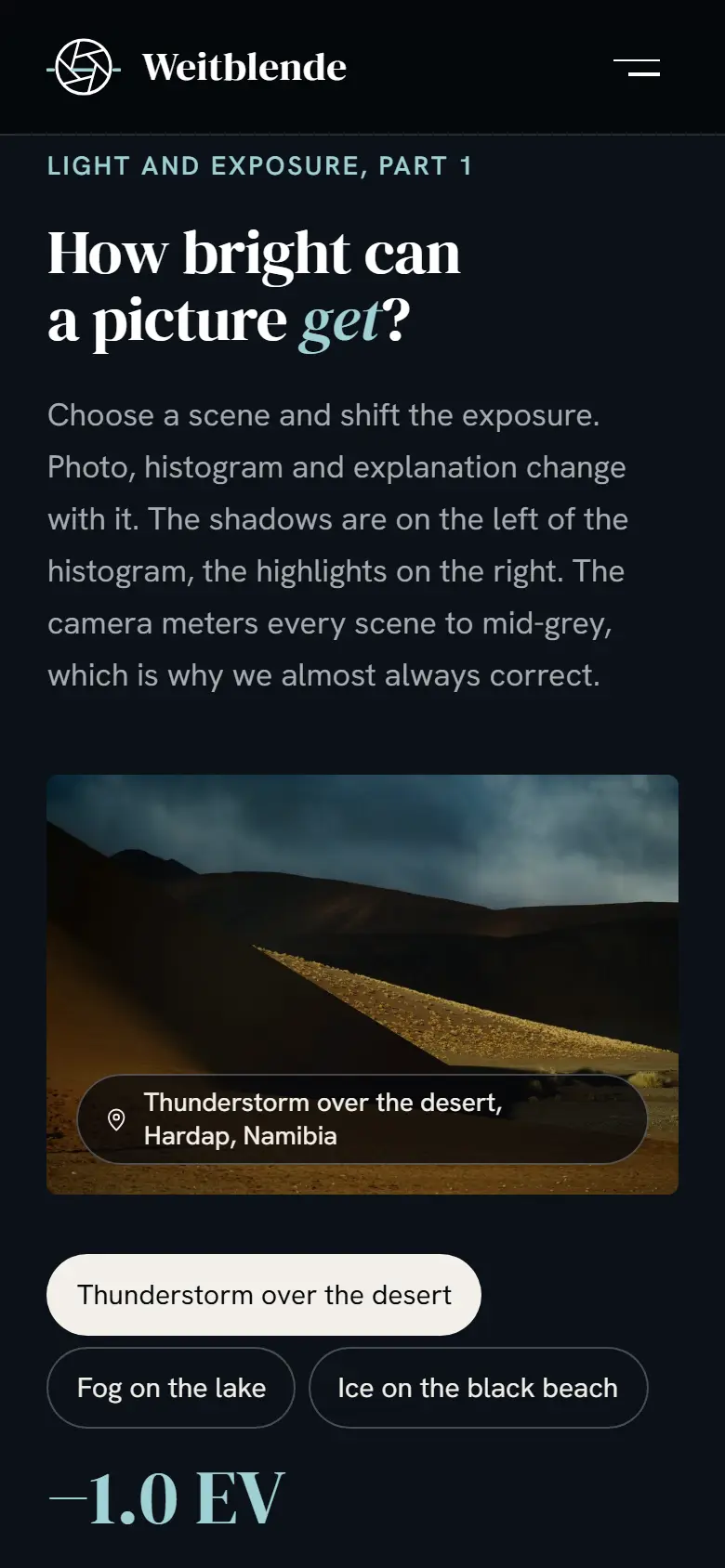
Three scenes, slider, histogram and target values
Light curve with tour choice, golden and blue hour
Places left as dots, then voices and journal



Three scenes, minus three to plus three stops
Photo and histogram follow the slider
Golden and blue hour in the travel month
Target and guide values work without scripts
You write what you want. Your AI knows how
The rules of the template for your AI
Not just squeezed together
Strategy and blueprint in the project
Switched to your brand in one sentence
Operators of photography tours in small groups
Photographers who lead their own tours abroad
Agencies that deliver tour operator sites reliably
Secure payment via Stripe, the ZIP arrives right after
Rather have it done for you?AI Website Service · €899First steps in the docs Template, service and custom pricing compared
Three scenes, a thunderstorm over the desert, fog on a lake and ice on a black beach. A slider moves the exposure from minus three to plus three stops in thirds, and four buttons jump to minus two, the camera reading, our own choice and plus two. Photo, histogram and explanation change with it and say when highlights or shadows clip. The build works out the histograms with sharp from the real images, the target values sit in src/data/probe.ts, and a table shows them even without a script.
From place, reference day, latitude, longitude and time zone per tour under licht in src/data/site.ts. The function in src/lib/licht.ts turns them into the sun elevation across the day, sunrise and sunset, the midday elevation and the golden hour between 4 degrees below and 6 degrees above the horizon, the blue hour between 6 and 4 degrees below. The hour slider moves in quarter hours, and a table gives the guide values for morning and evening. On the home page you choose the tour, every tour page shows its own. The times are calculated, not measured, and appear as guide values for the middle of the month with an open horizon. For Reine in February the calculation gives sunrise at about 8:29, sunset at about 16:15 and a midday elevation of 9 degrees.
No. The only calculation is about the sun. The Lofoten tour calls the northern lights a chance and says plainly that nobody can promise them. If you want to work out how dark a night gets, Funkenmoos does that with its Night Window.
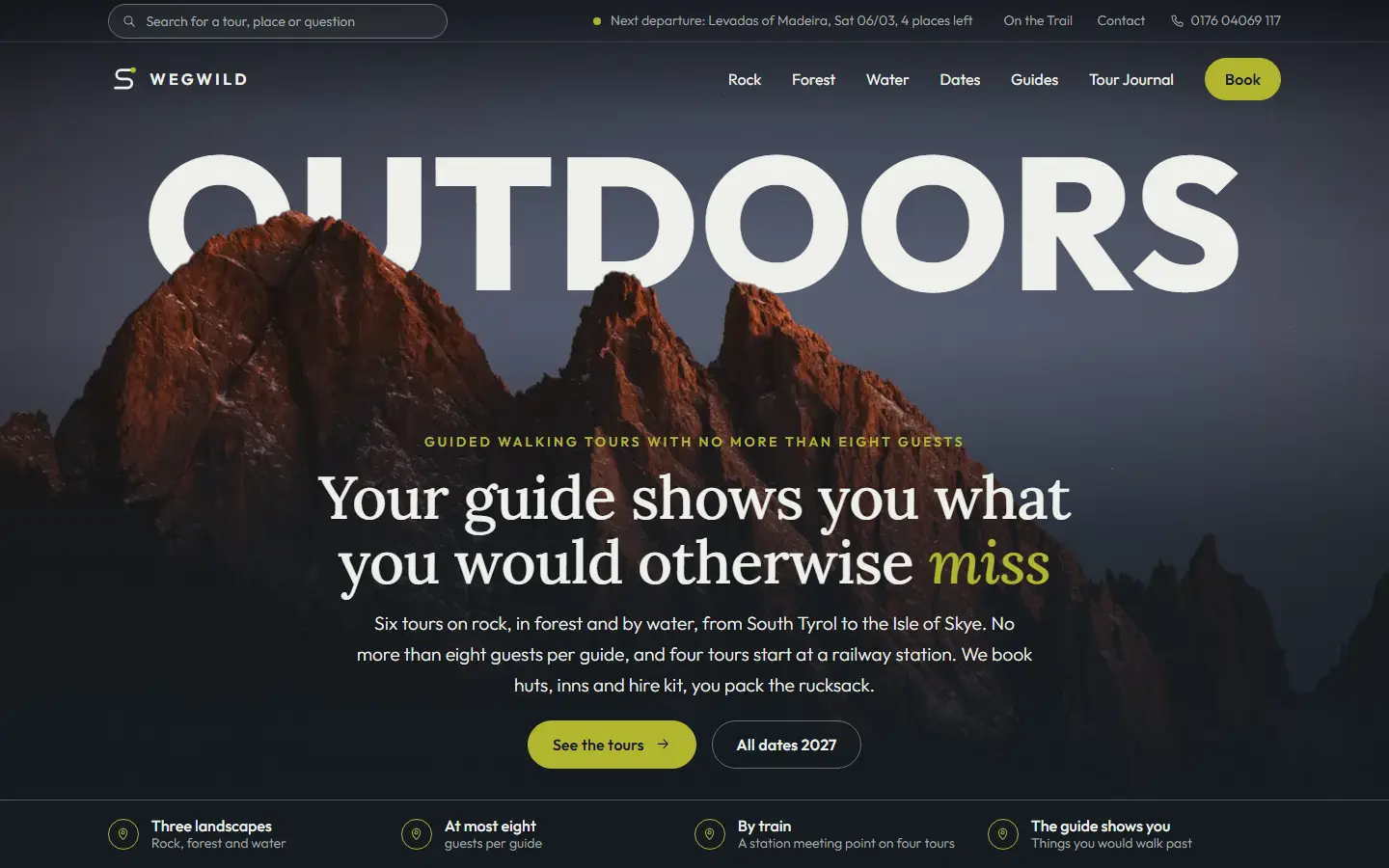
Wegwild is built for guided hiking tours and Kehrwelt for cycling holidays without flying, where the route counts. With Weitblende the group stays several mornings at the same scene, and the site explains light and exposure, with scenes and their camera settings, image review, Photo School and a packing list for the camera.
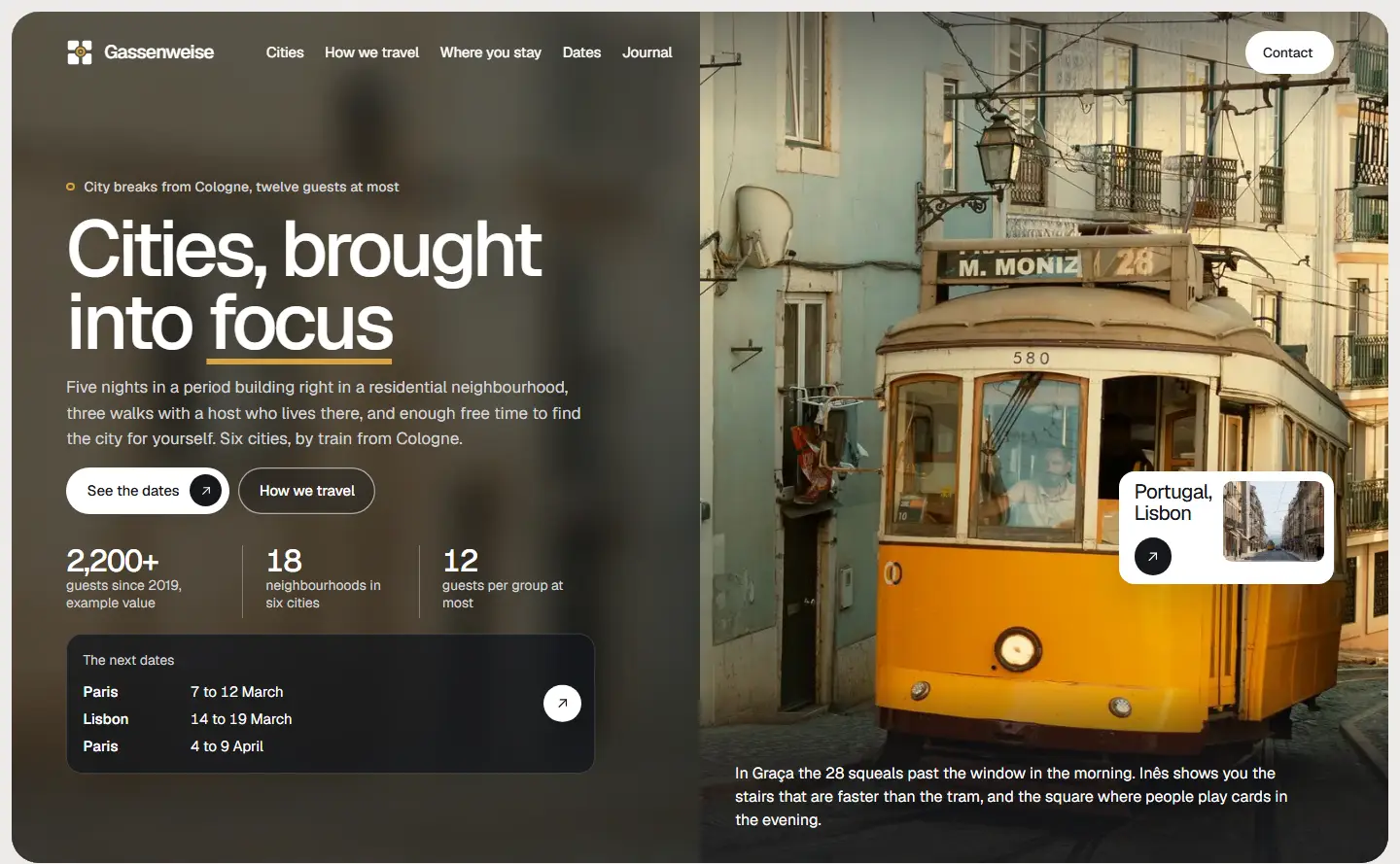
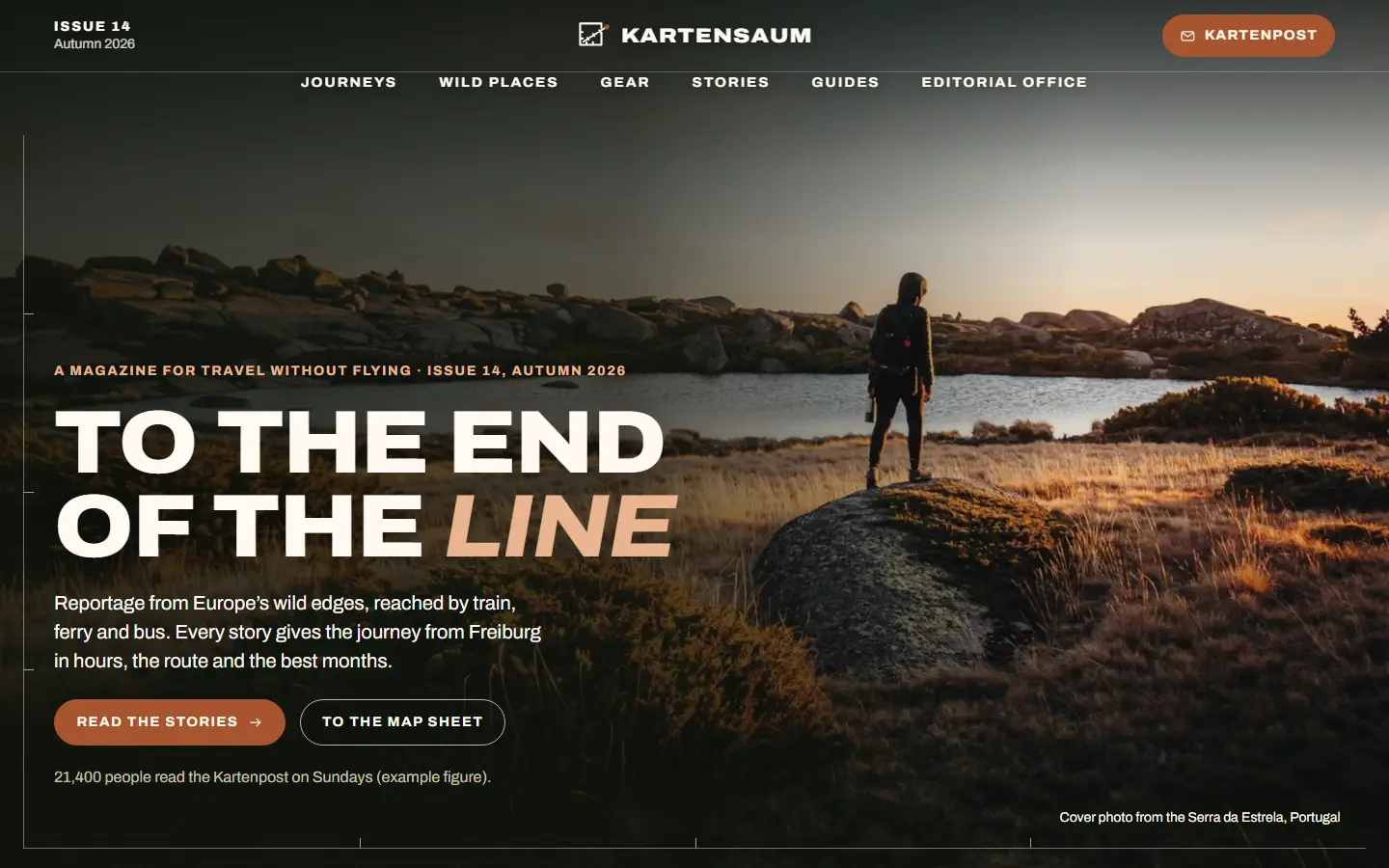
There are separate templates for those in the same category. Funkenmoos is built for glamping, Lauschgrat for holiday cabins, Gassenweise for city breaks in small groups, and Kartensaum is a travel magazine that sells no tours. Weitblende sells tours with fixed dates, a tour leader and booking conditions.
The six tours sit on the home page as wide chapter bands with an exposure scale and the camera settings of the image. With a script each band comes in slightly underexposed and reaches correct exposure as you scroll, and the layer lies only over the photo, never over the text. Without a script and with reduced motion the chapter bands stand correctly exposed right away.
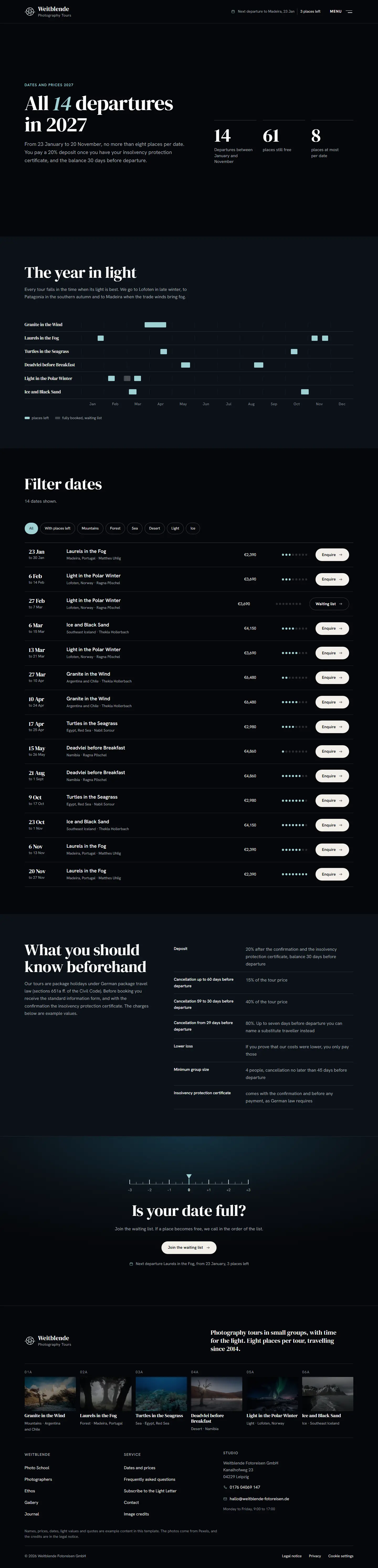
A fact sheet with duration, price, level and next departure, four facts on arrival, accommodation, walking and landscape, the light curve of the travel month, five stops, three or four scenes with the setting the tour leader starts with, price with deposit, what is included and what is not, a list for your backpack, the dates with places left as dots, the tour leader as initials and five questions. All six pages come from src/pages/reisen/[slug].astro.
With an entry in reisen in src/data/site.ts, with title, place, duration, price, level, tour leader, dates, stops, scenes, inclusions, questions and the details for the light curve. That produces the tour page, the band on the home page, the comparison, the dates, the tour finder and the footer. You write the opening in src/data/heros.ts, the alt texts sit in src/data/alt.ts, the credits of new images in src/data/bildnachweis.json. Dates are a list per tour with day and places left, and from them the dates page, the year band, the dots, the key figures and the next departure in the header are worked out, which the browser recalculates from today. The dates are sample data for 2027.
Yes, as samples. The dates page says that the tours are package holidays under sections 651a ff. of the German Civil Code (BGB), with the standard information form before booking, the insolvency protection certificate before any payment, a 20% deposit and a cancellation scale as a sample value. The legal notice is a guide for tour operators, with insolvency protection through the German Travel Security Fund (Deutscher Reisesicherungsfonds) or an insurance policy. Have your terms checked before going live, these notes are not legal advice.
No, there is no booking system built in. Every date leads to the enquiry, where tour and month are already chosen and the date stands in the message. The form checks the fields, marks errors at the field, and the message disappears as you type. Afterwards a confirmation appears that says plainly that the template sends nothing. Contact and Light Letter use method="post", and your AI connects the sending or a booking system and adds it to the privacy policy and the consent.
Three questions, what draws you, how much cold you like and how much you want to walk. Every answer gives matching tours points, and the suggestion changes after each answer. The questions and which answer leads to which tour sit at the top of src/pages/reisen/index.astro. Without JavaScript all six tours appear with text and link.
The aperture on the Photo School runs from f/1.8 to f/22 and shows for a 35 millimetre lens focused at five metres where sharpness starts and ends and which trees turn soft. The packing list has twelve items with weights, adds them up against eight kilograms of cabin baggage and starts at 3.11 kg. Without a script both show their starting value from the same calculation.
Six rules on the road, the estimated CO₂ of the flight per person and tour as bars with the climate contribution in the price, and two per cent for a bog restoration project in the Ore Mountains. Values and project are example values and marked as such, and the page promises no offset of the flight. Environmental claims on your website need evidence, so check your figures and partners before going live.
Yes. Every heading and every text is there without a script. The exposure test shows the target value and its table, the light curve a drawn curve with a table of guide values, the chapter bands stand correctly exposed, aperture and packing list show their starting value, accordions stand open, gallery and dates show everything without a filter, and the menu opens on phones.
No. Business, team, prices, dates, testimonials, workshops and the bog restoration project in the Ore Mountains are made up, and the footer of every page says so. The address in Leipzig is an example, the phone number comes from the block the German Federal Network Agency keeps free for media. Destinations, national parks and photo spots such as Fitz Roy, Deadvlei, Reine and Vestrahorn are real places, accommodation and local partners are not named.
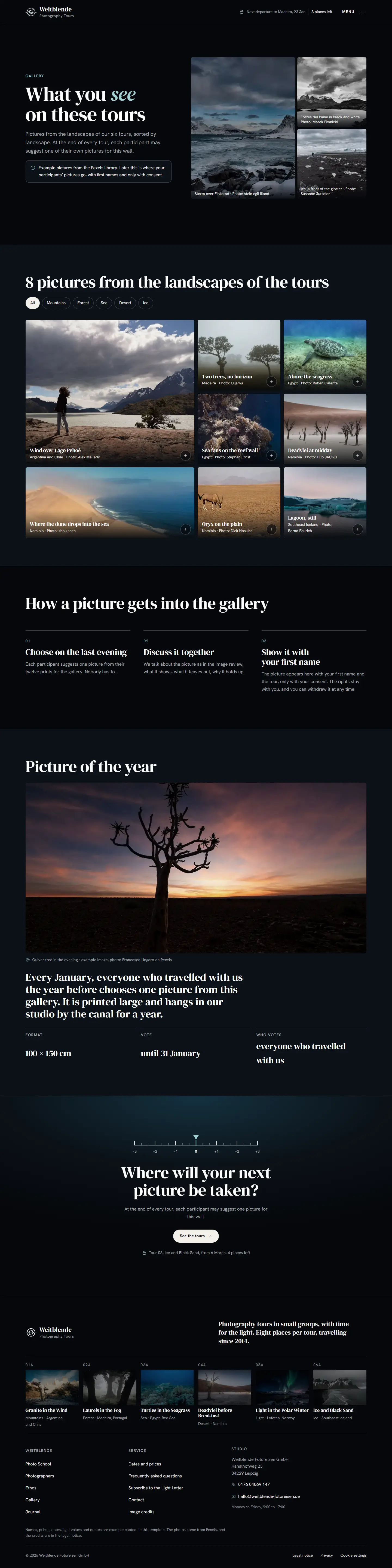
The 56 photos come from Pexels under the Pexels licence, and none is generated by AI. They show neither the team nor participants of a real tour. Twelve photos show people, none with a recognisable face, and there is no model release. The gallery names the photographer on Pexels under every image, and src/data/bildnachweis.json and the legal notice list every image.
Because no stock photo should stand next to a real name. The four tour leaders appear as initial plaques with the aperture mark, their role and their tours, and the note below says that photos of your own tour leaders belong in that spot. The voices appear without faces and marked as example quotes.
No. DM Serif Display and Hanken Grotesk sit in public/fonts/, the photos in the project, and curves, histograms, scales and logo mark are drawn. The browser runs its own JavaScript without a library, about 8 KB gzip. The cookie dialog writes the choice to the dataLayer, statistics and marketing are not tied to any service.
Yes. Every page has its own title, description and breadcrumbs, plus a TravelAgency schema and a TouristTrip per tour with one offer per date. The questions on the tour pages carry FAQPage, the articles BlogPosting. Astro builds the share images at 1200 by 630 pixels from a photo of each page. Legal notice, privacy and 404 are set to noindex and left out of the sitemap.
Informal you throughout, and the operator speaks as we. The sentences of scripts and components sit in src/data/texte.ts, the openings of all pages in src/data/heros.ts, tours, team and articles in src/data/site.ts. Your AI switches the tone if your business prefers a more formal voice.
Yes. In the English package the whole website is in English, with an English knowledge layer and English skills. The scripts format numbers, times, dates and euros in the language of the page.
Anywhere static files may live. Astro builds the site into a folder of finished HTML that you upload to your host. Before that, your AI sets your own domain in astro.config.mjs and robots.txt, and the website derives every other address from it.
Yes. Pay once, yours for good, for your own projects and client projects. You get the complete source code without a watermark.
No. You tell your AI in the project folder what should change, and it finds the spot through CLAUDE.md and the seven skills. If you want to work by hand, tours, dates, team and articles are in src/data/site.ts and the scenes of the exposure test in src/data/probe.ts.
 New in the marketplace
The website for city breaks in small groups, with a flat in the neighbourhood and three walks per city.
 New in the marketplace
The website for travel magazines and blogs that shows the journey to every destination in hours, without flying.
 New in the marketplace
The website for guided walking tours in small groups, where the guide points out in the photo what you see on the trail.
 New in the marketplace
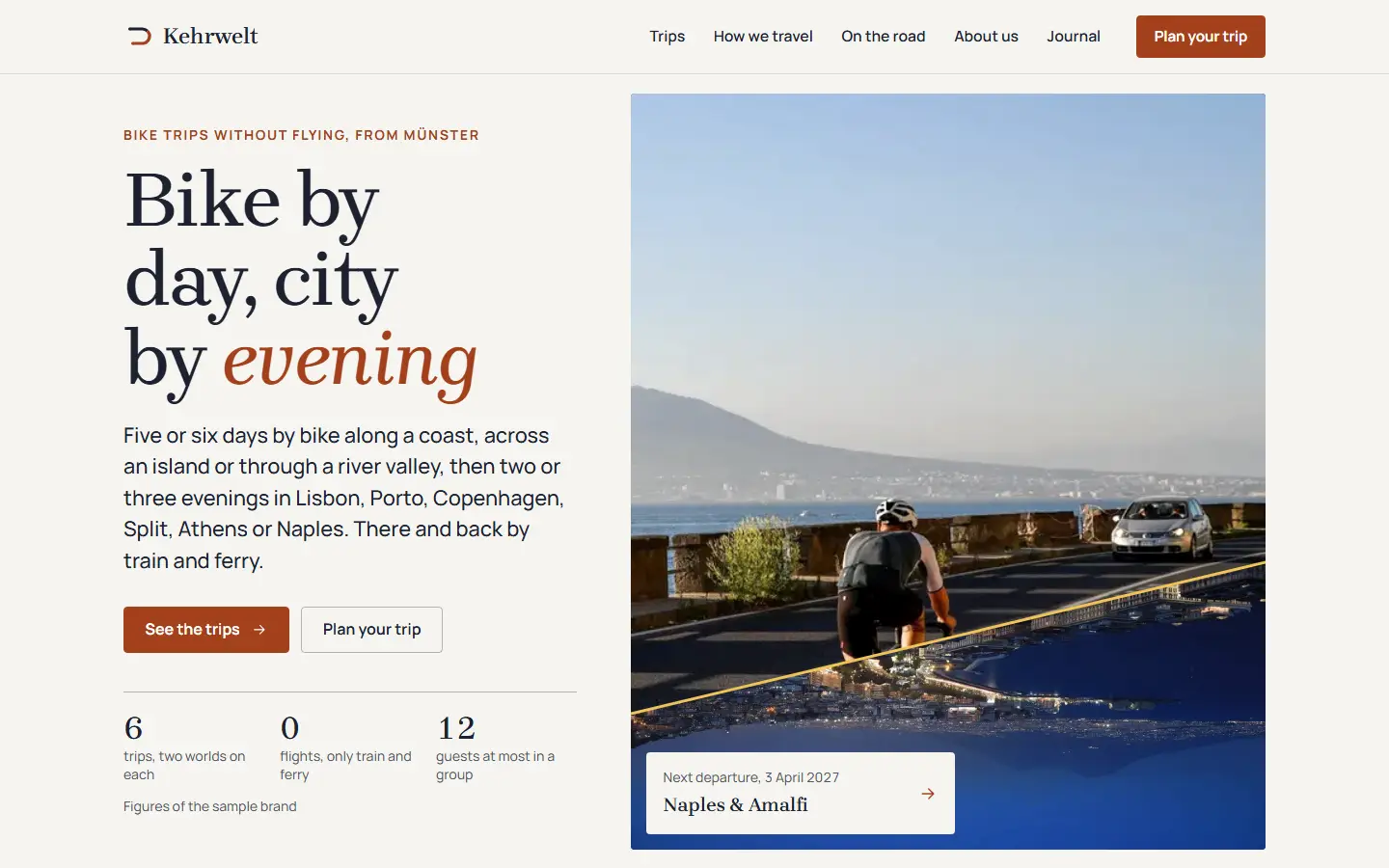
The website for cycling holidays without flying, showing every trip as a day on the bike and an evening in the city.
We would like to understand how this site is used with Google Analytics, loaded via Google Tag Manager. Nothing loads and no cookie is set before your ok. You can change your choice anytime in the privacy policy.
Choose what may be active. You can change your selection anytime in the privacy policy.